Marcel Huber

Projects

Software I build in my own time. Click a stack of screenshots to flip through it, or enlarge one with⤢. MakerWorld models live on the 3D printing page.

Woodquarter Labs · Sep 2026

LanternStudio

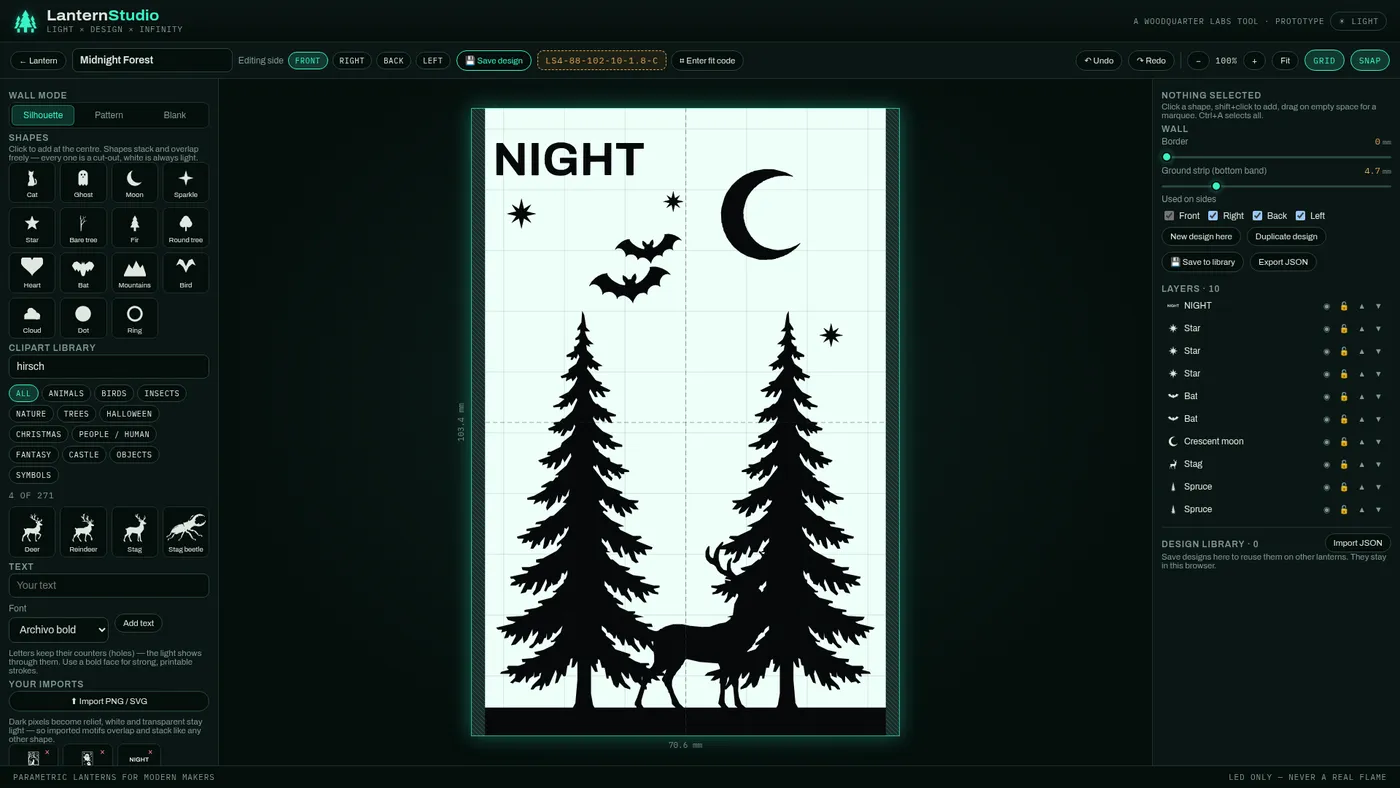
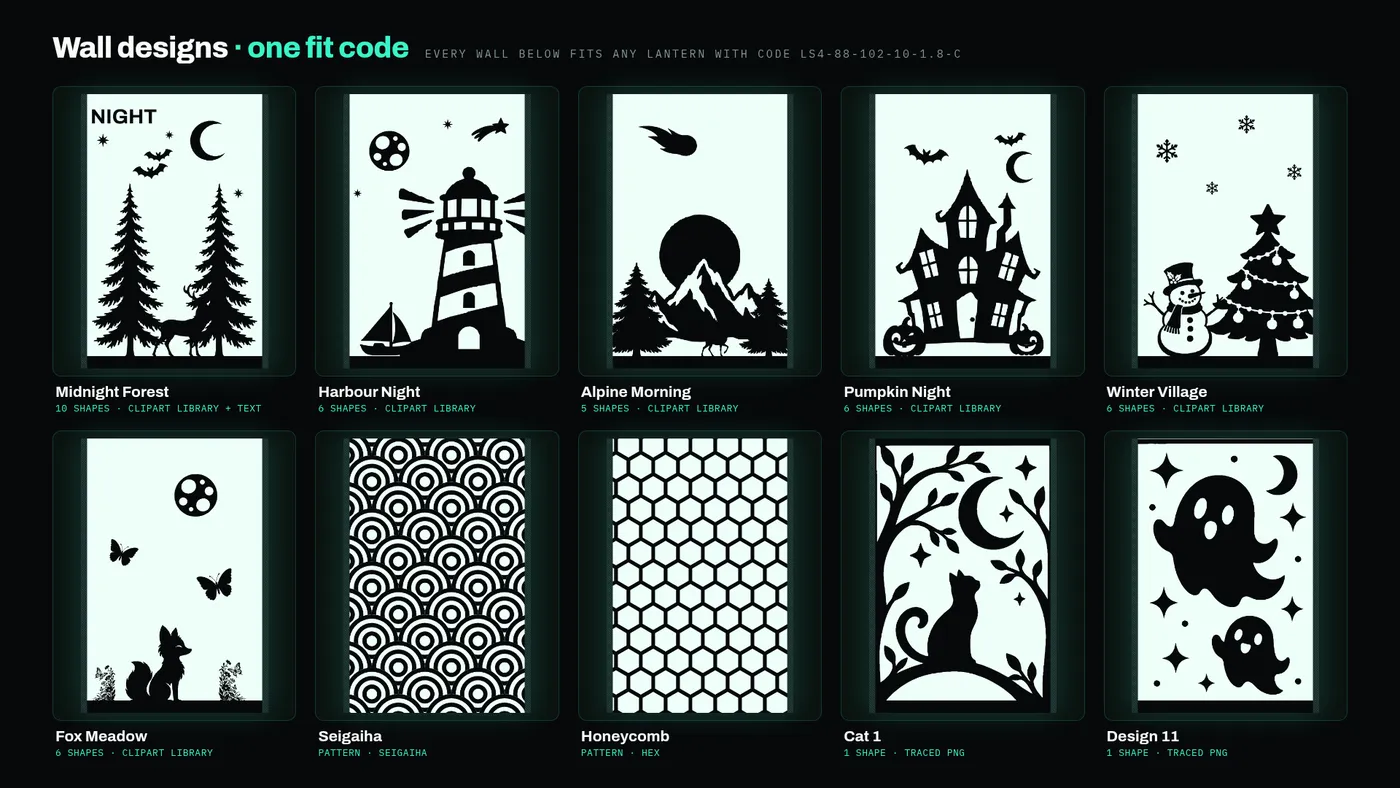
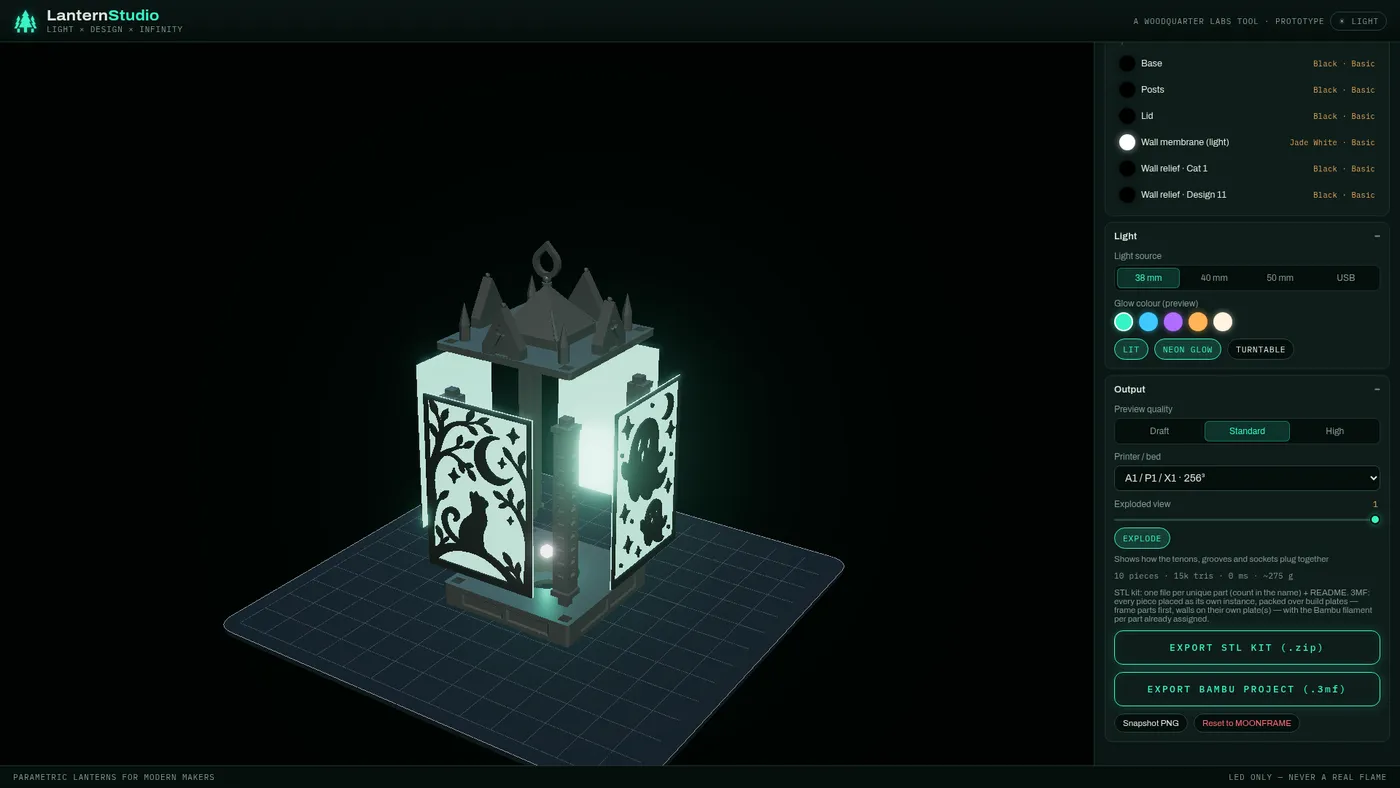
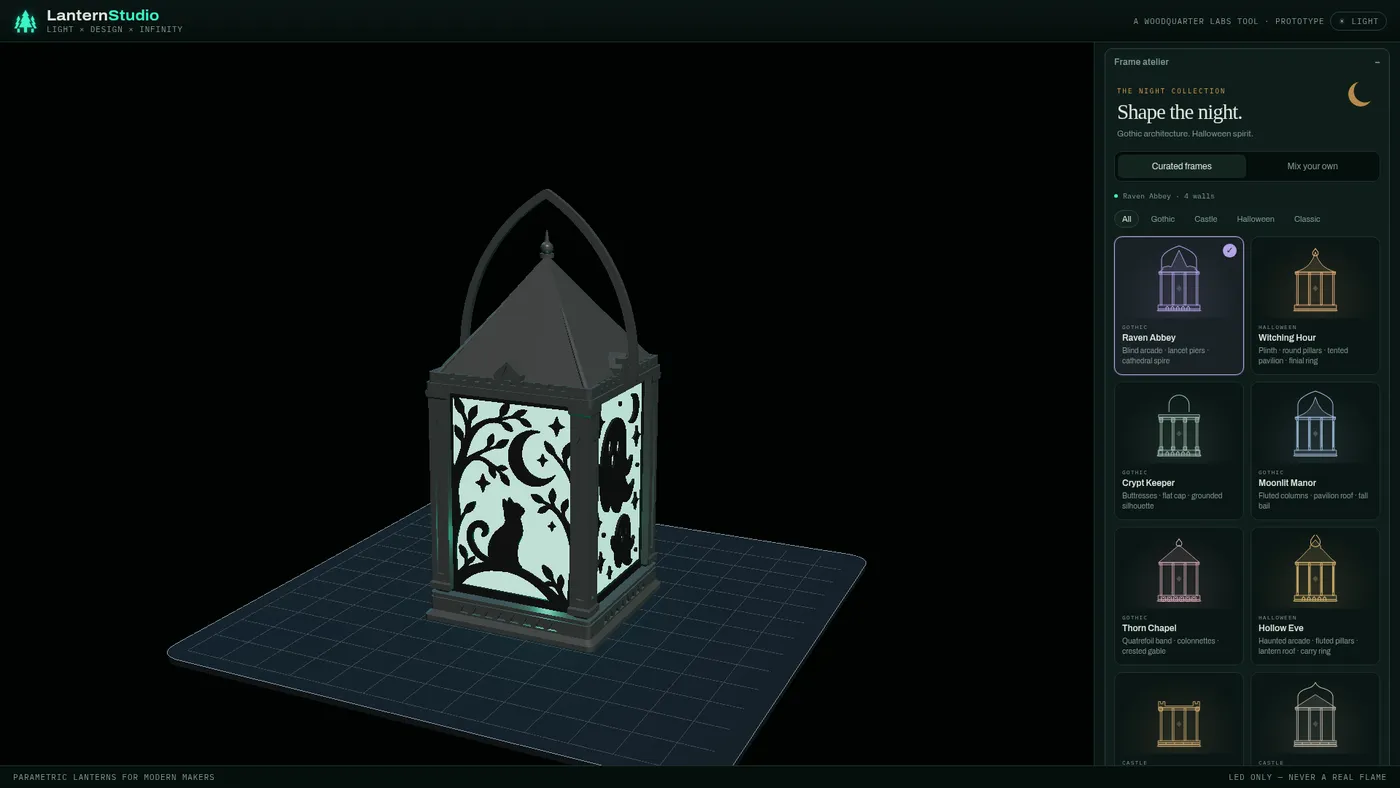
LanternStudio is a browser app for designing your own 3D-printable lanterns, from the frame down to the light-silhouette walls.
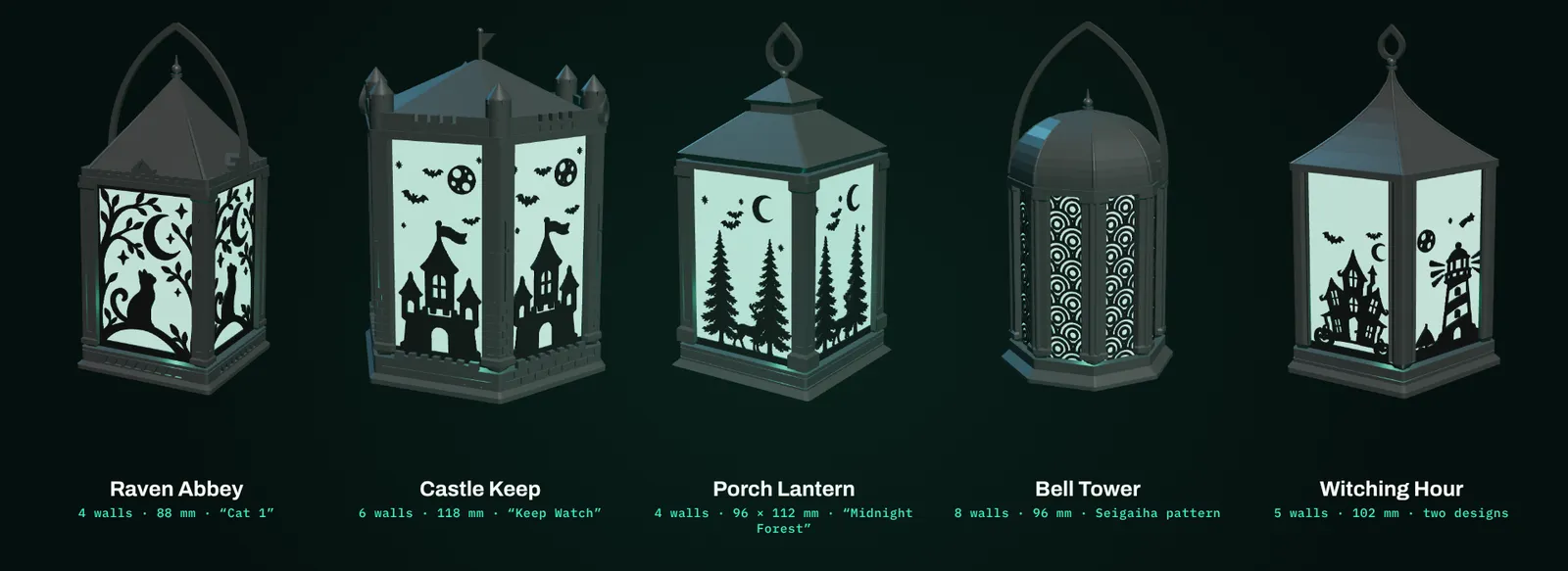
Five lanterns generated from the same parametric model

1 / 5 Five lanterns generated from the same parametric model

Pick one of 14 curated frames or mix your own from bases, pillars, roofs and handles, then design every wall with clipart, text, patterns or a traced image. LanternStudio exports a print-ready kit in which every part prints flat and without supports.

A manifold-3d geometry kernel builds and checks every part directly in the browser, so what you see in the 3D preview is exactly what the slicer gets.

  • 75,000+ frames. Lanterns with 3 to 8 sides from valid combinations of bases, pillars, roofs and handles.
  • Wall editor. A 271-piece clipart library, text, patterns and image tracing; drop in a PNG and it becomes a printable relief.
  • Fit codes. Every wall slot has a code, so a wall designed for one lantern swaps one-to-one into any lantern with the same code.
  • Tested geometry. Roof and handle pairs are collision-checked by the kernel, and 103 automated fit tests guard the joints.
  • Ready to print. An STL kit or a Bambu Studio project with the plates laid out, including a threaded LED base with a removable cartridge.

Woodquarter Labs · Jun 2026

Bowl Builder

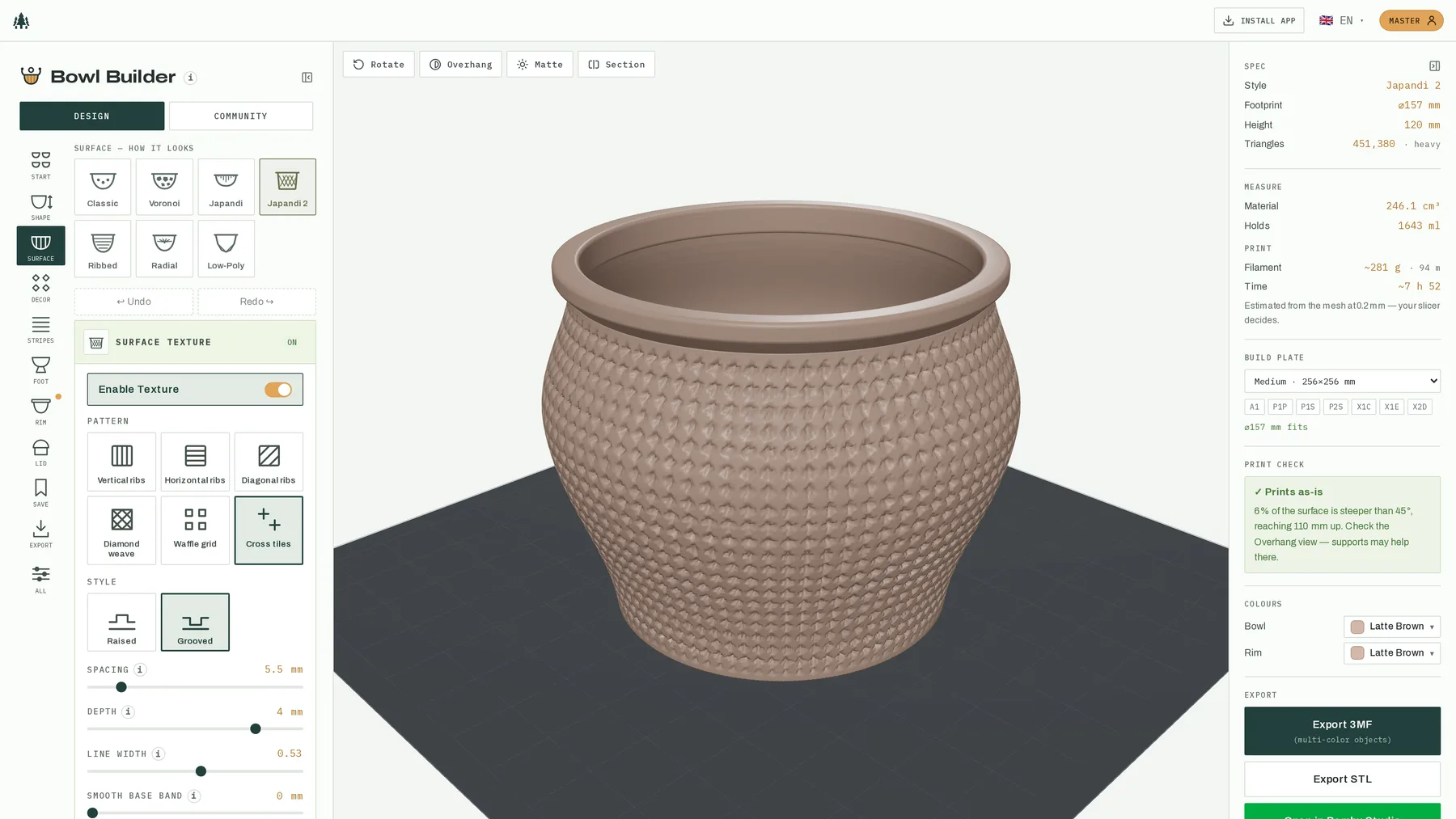
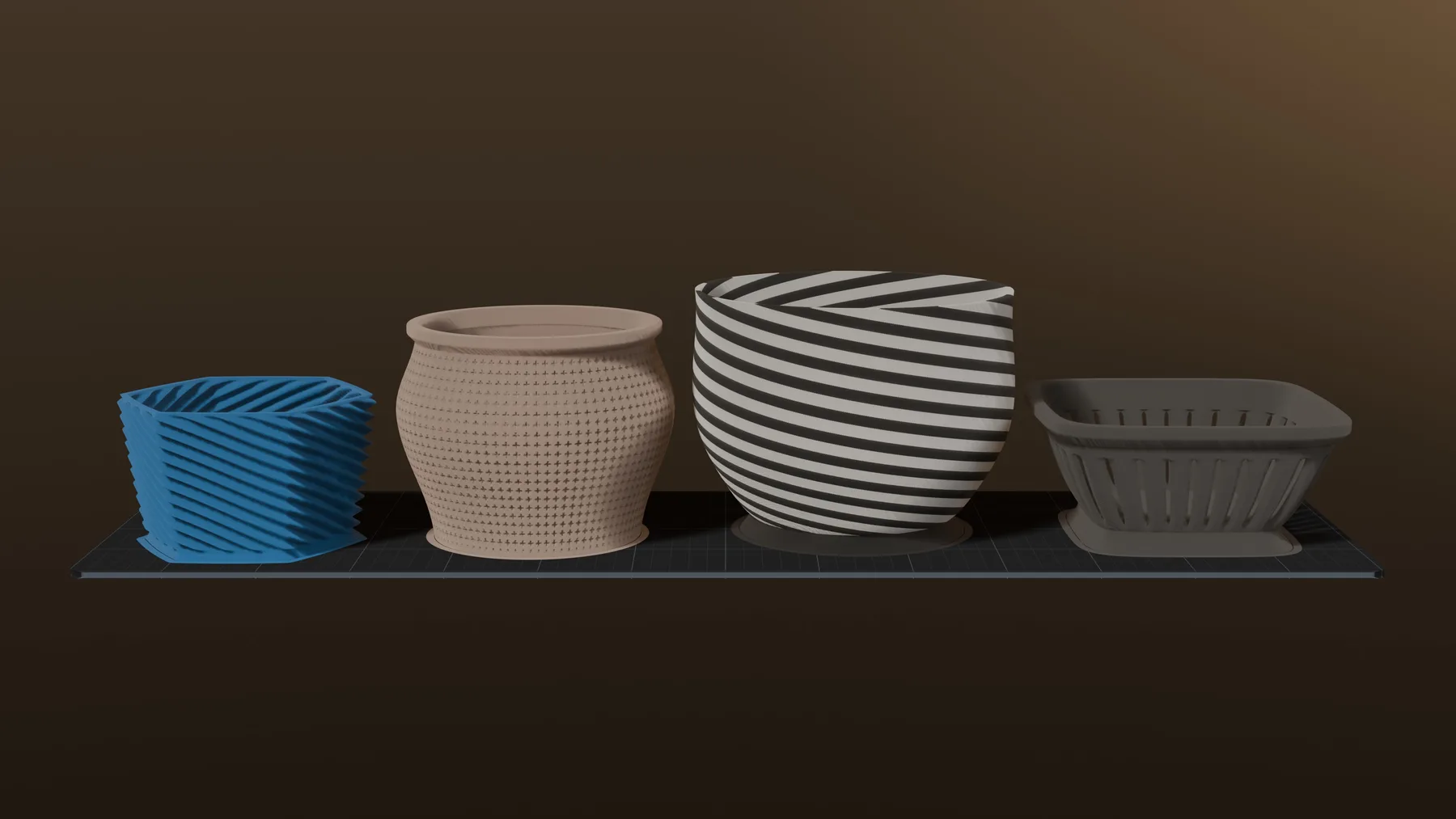
Bowl Builder is a parametric design tool for 3D-printable bowls that runs entirely in the browser.

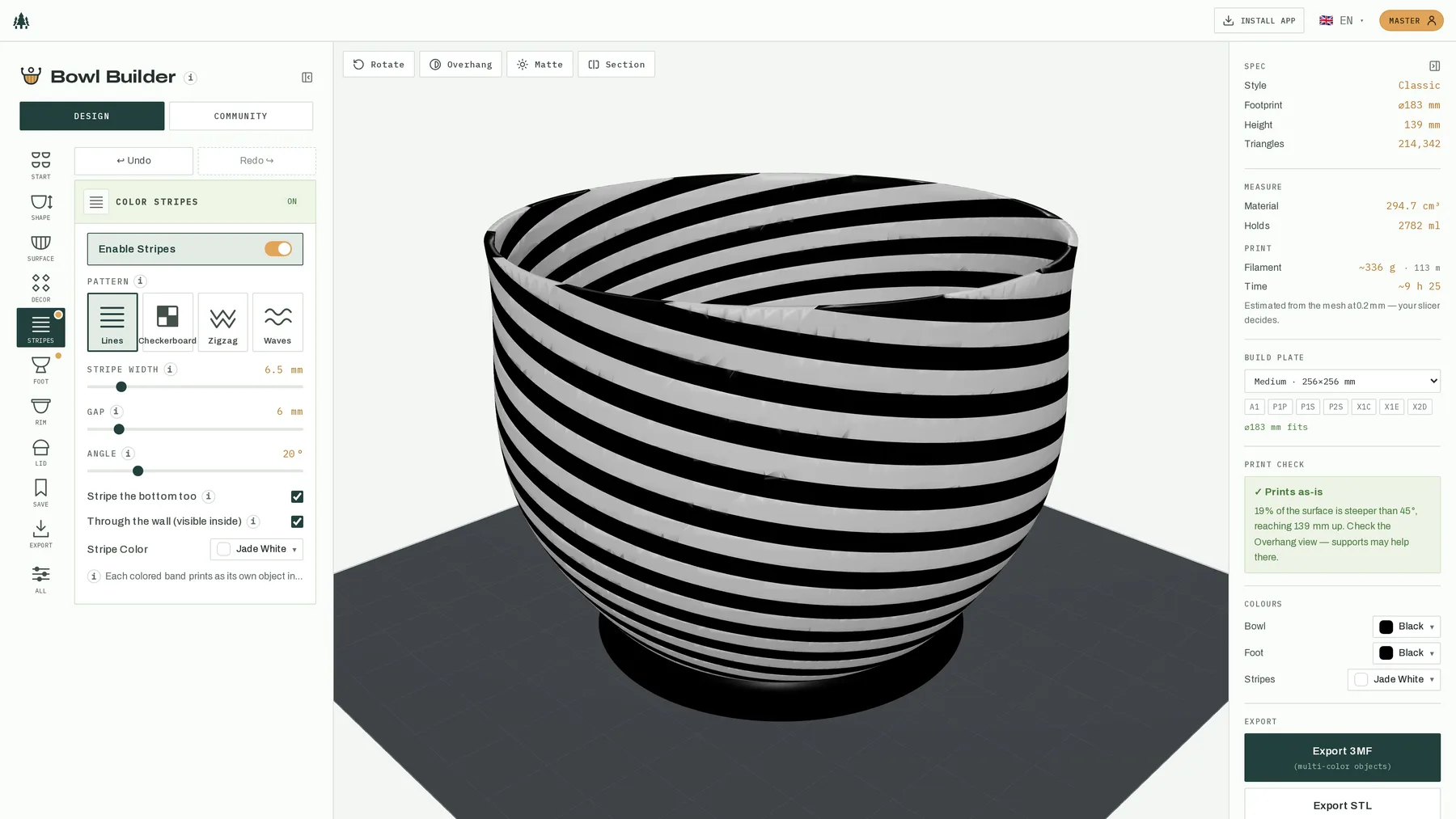
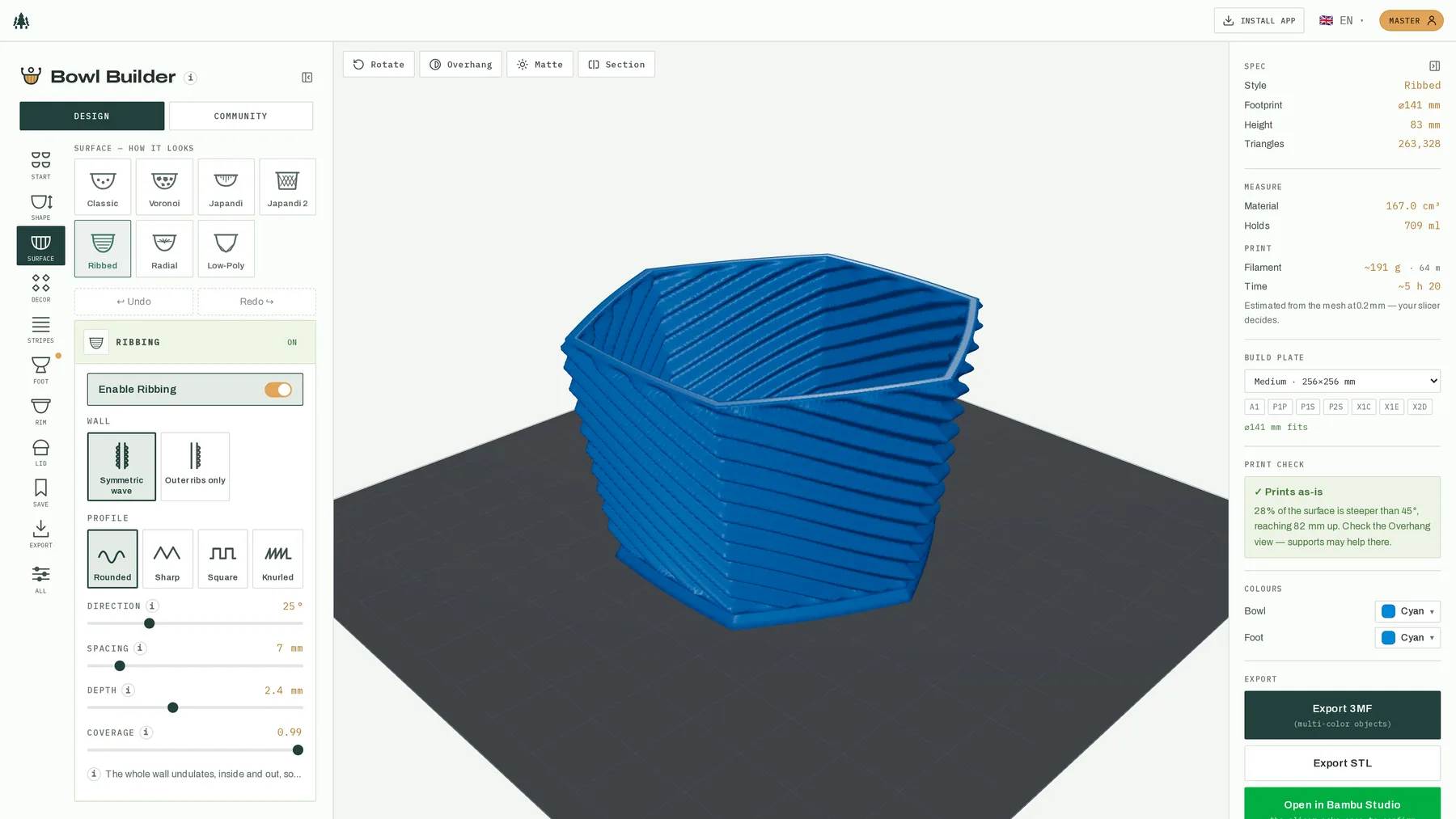
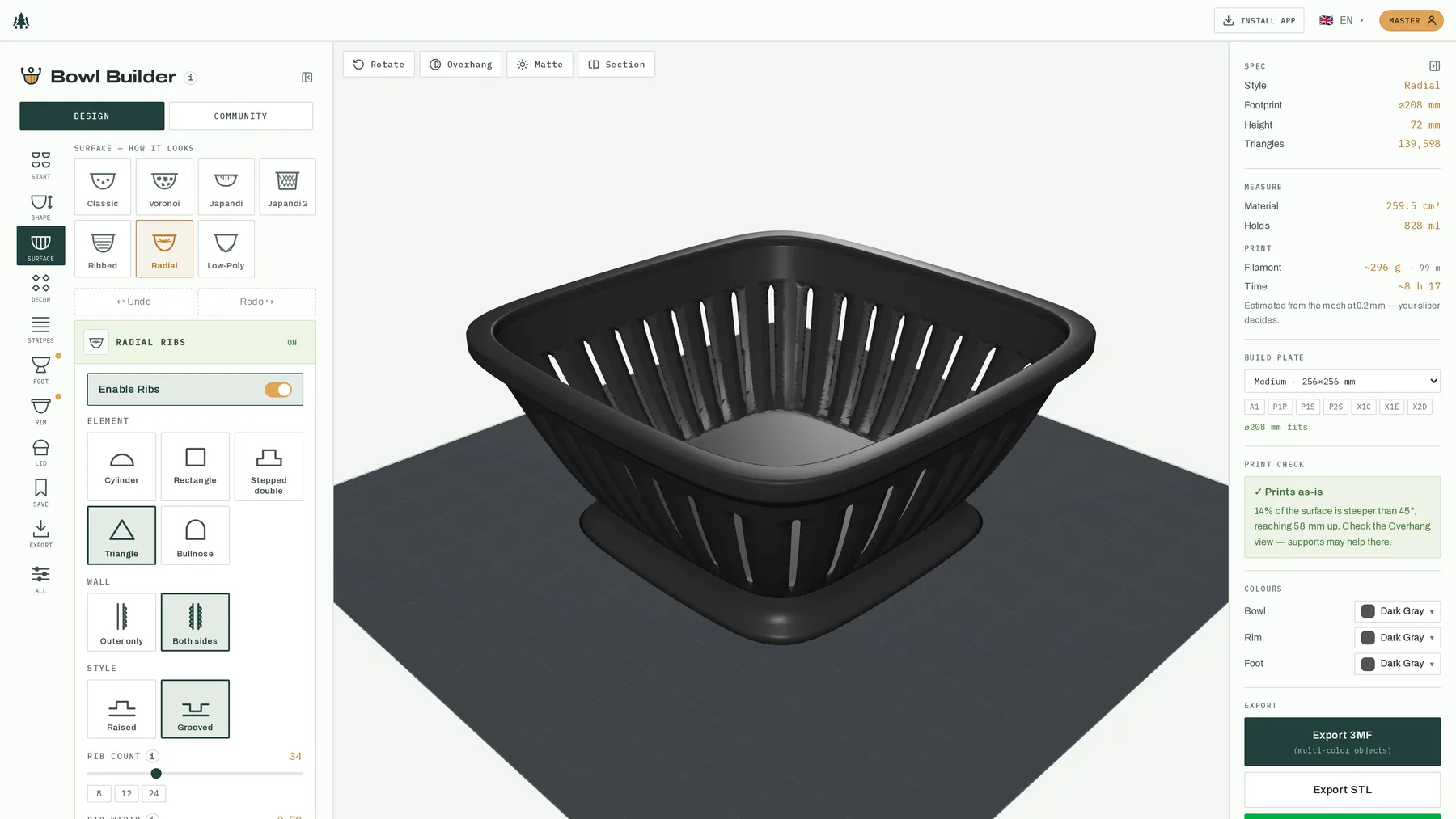
Four bowls designed in Bowl Builder: a twisted blue planter, a dotted-texture pot, a striped bowl and a square basket

1 / 5 Four bowls designed in Bowl Builder: a twisted blue planter, a dotted-texture pot, a striped bowl and a square basket

You set the shape, wall style and pattern with a few controls and watch the bowl update live in 3D. One click exports an STL or 3MF file for the slicer.

Several of my MakerWorld releases were designed with it, among them the Modern Ribbed Toothbrush Holder Collection.

  • Two modes. Classic solid bowls, and Voronoi lattices with cells cut through the wall.
  • Printable by design. Support reduction reshapes overhanging cells so lattices print without supports.
  • Details. Patterns, stripes, rim text and a pedestal foot.
  • Save and share. Designs are stored and can be shared with others.
  • Platform. Accounts, a design gallery and access tiers in a Next.js app, crowdfunded on MakerWorld.

Woodquarter Labs · Jul 2026

BlenderRender

BlenderRender is an MCP server that lets an AI agent such as Claude Code turn a 3D-print project into a rendered timelapse video.

1 / 5 Three Halloween figures printing layer by layer, rendered by BlenderRender

Ask “render a timelapse of this print” and the agent inspects the 3MF project, slices it headlessly, renders the print layer by layer in Blender and hands back the finished MP4.

The interesting part is the tool design: what an LLM needs to drive a slow pipeline with many steps reliably, without a human in between.

  • Six tools. Inspect a project, parse G-code, list options, slice, render, and check a job.
  • Background jobs. Renders take minutes, longer than a tool call may block, so slicing and rendering run in the background and the model polls until the video is ready.
  • Agent guide. Recipes, defaults and failure modes, so the model reads the real filament colours and picks a contrasting support colour instead of guessing.
  • Real extrusion. Parses Bambu, Orca and Prusa G-code for each segment’s role, width, layer and tool, then sweeps the beads in Blender with a three-phase camera rig.
  • Testable. Blender’s Python and the system Python only exchange an .npz file and a job spec, so 163 tests run without launching Blender.

Woodquarter Labs · Jul 2026

MakerStats

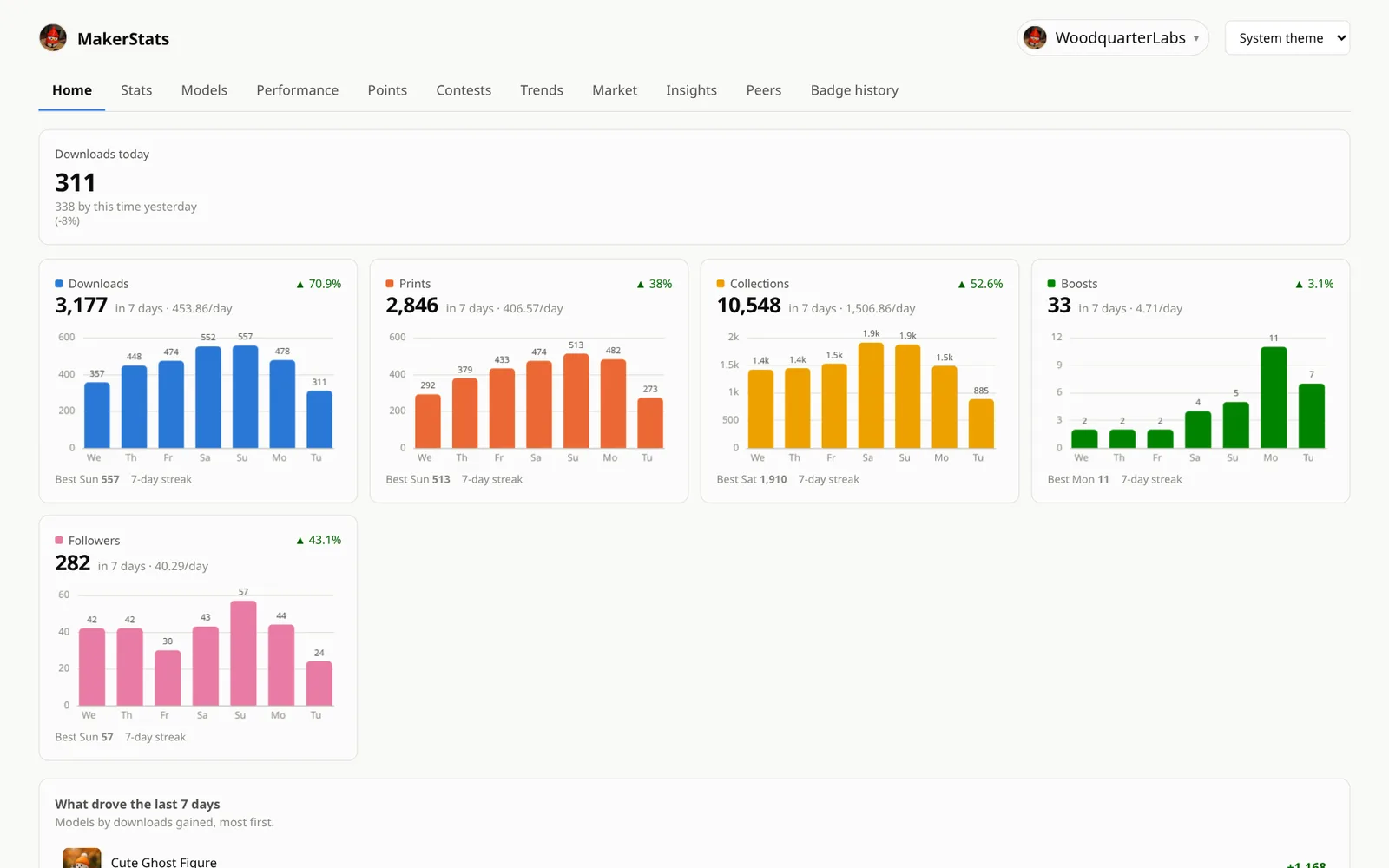
MakerStats is my self-hosted analytics platform for MakerWorld: it records every download, print and follower of my 3D models and turns them into decisions about what to design next.

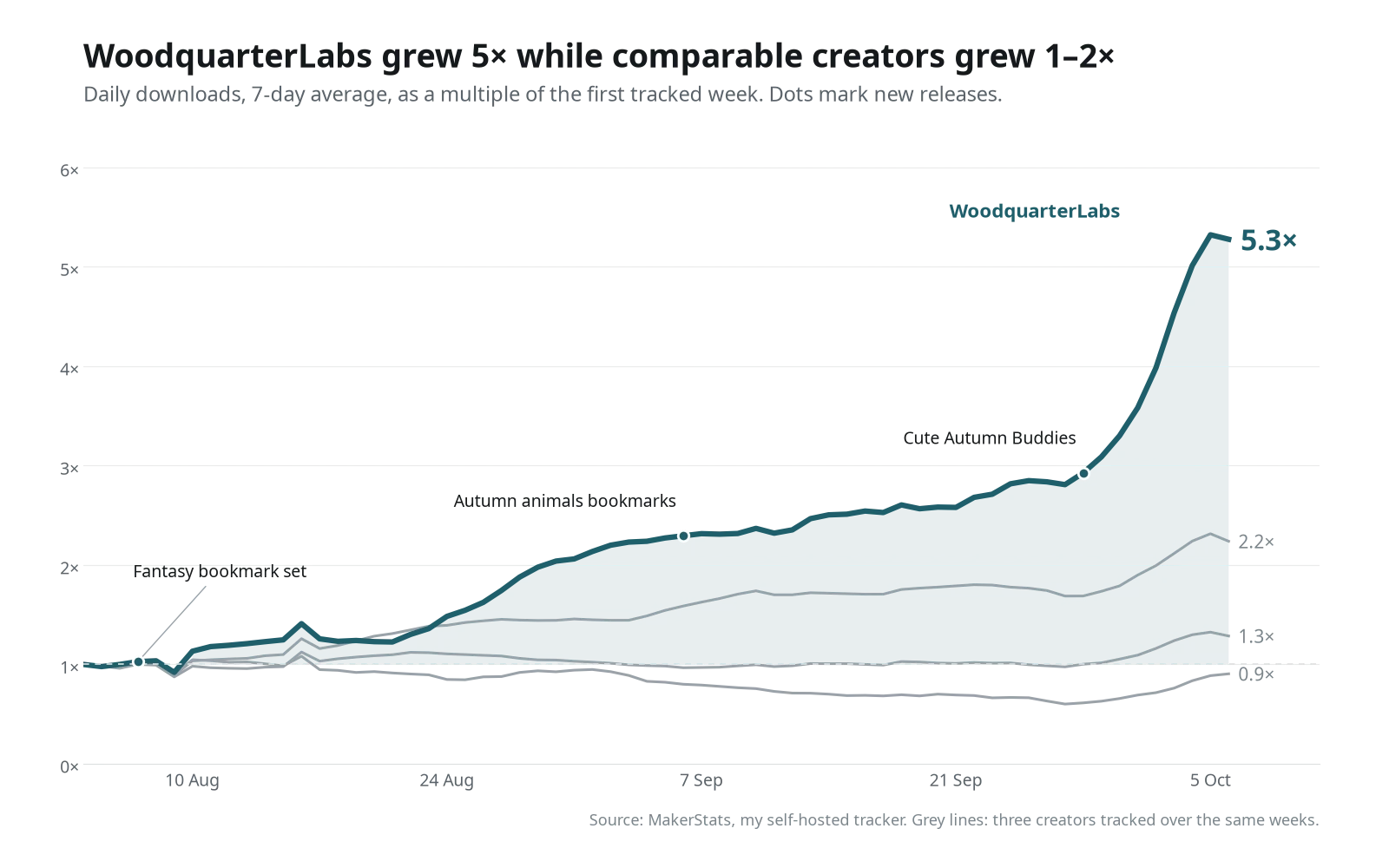
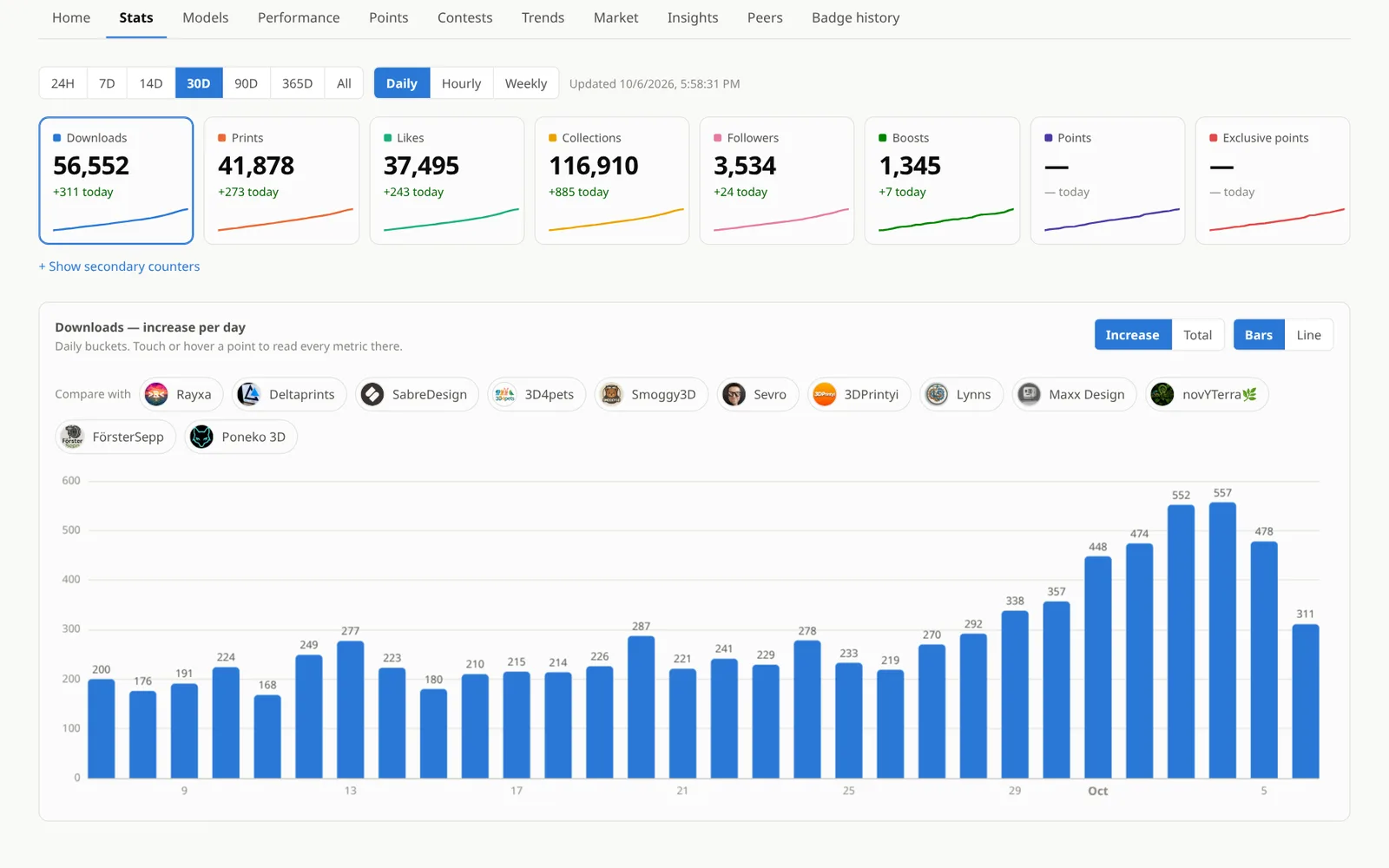
Chart: WoodquarterLabs daily downloads grew 5.3× since late July, while three comparable creators grew between 0.9× and 2.2×

1 / 5 Chart: WoodquarterLabs daily downloads grew 5.3× since late July, while three comparable creators grew between 0.9× and 2.2×

MakerWorld only shows running totals, so in July 2026 I built my own tracker. Since then my daily downloads grew from about 86 to about 454, 5.3×, while three comparable creators tracked over the same weeks grew between 0.9× and 2.2×, and the platform’s trending index stayed flat.

This is where my AI degree, with its large share of data science, pays off. The habits from research carry over directly: clean time series, a baseline, a comparison group, and checking whether a pattern is real or just the season, before deciding what to design next.

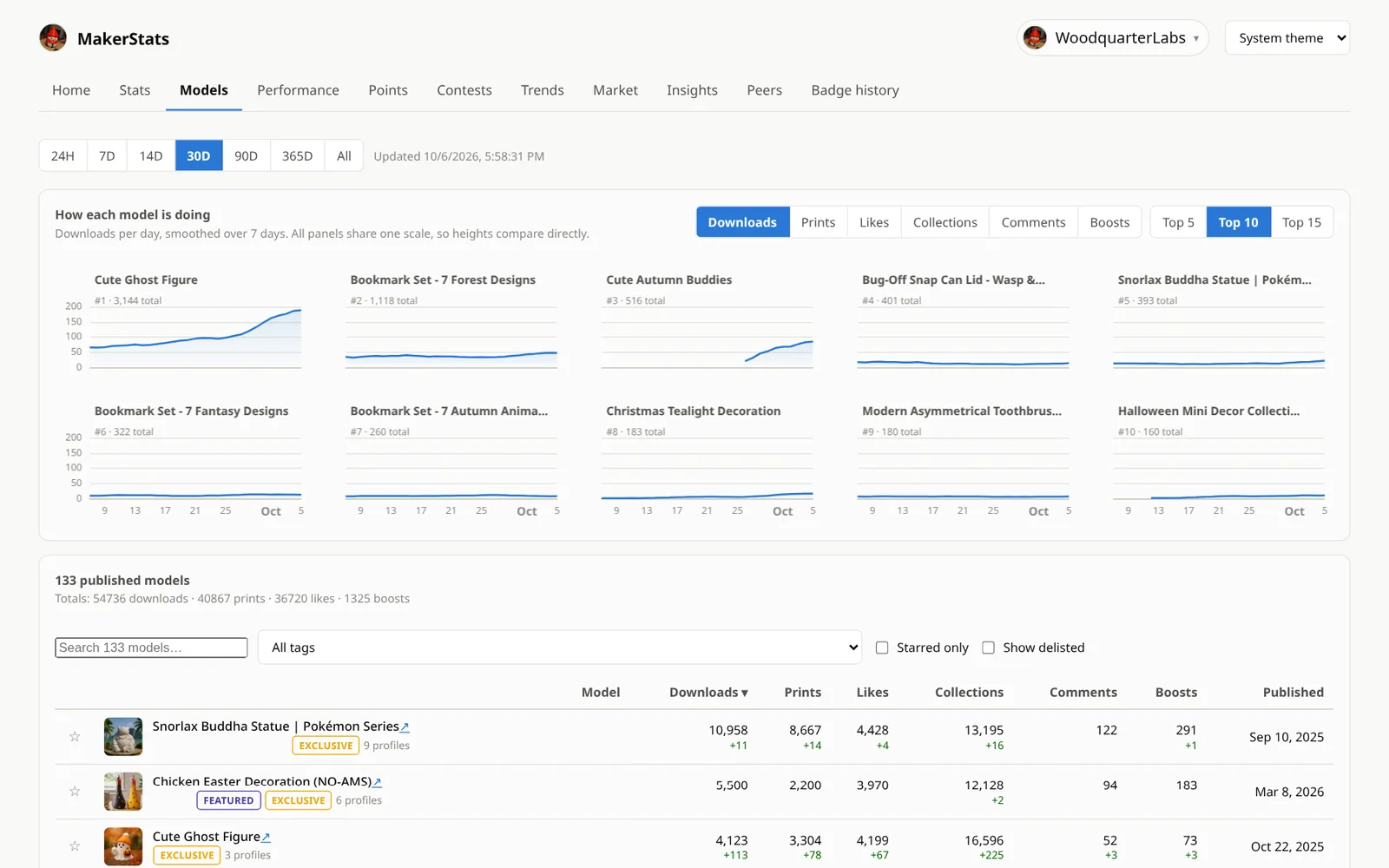
  • Series beat one-offs. How my first bookmark set moved told me what to design next, so the forest set got follow-ups with fantasy and autumn-animal designs.
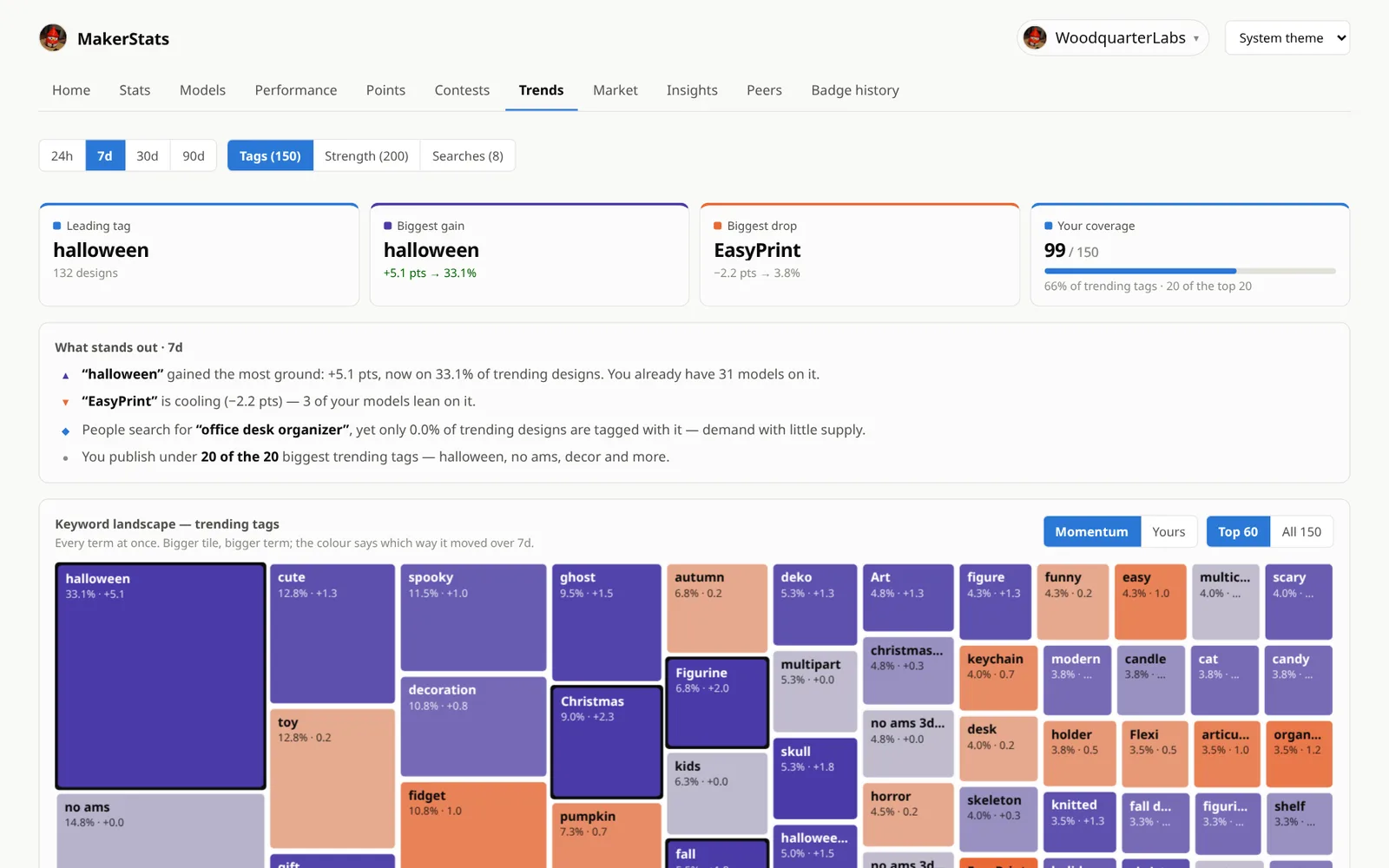
  • Early, not just seasonal. Seasons are predictable; the timing is the hard part. My tag and trend explorers show which tags are still rising, so I publish while a trend is growing and I’m still early. “Halloween” climbed to a third of all trending designs, and my autumn releases now bring in about half of new downloads.
  • Context, not just counts. Peer comparison and a platform-wide index show whether a good week is my work or the whole site.
  • Honest analytics. I removed a seven-panel analytics tab whose forecast and anomaly charts only restated the obvious, and kept the one panel that answered a real question.
  • Built like research code. Every upstream response is archived in TimescaleDB, 295 tests cover the parsers and analytics, and backups run nightly.

Personal project · Aug 2026

Greissler

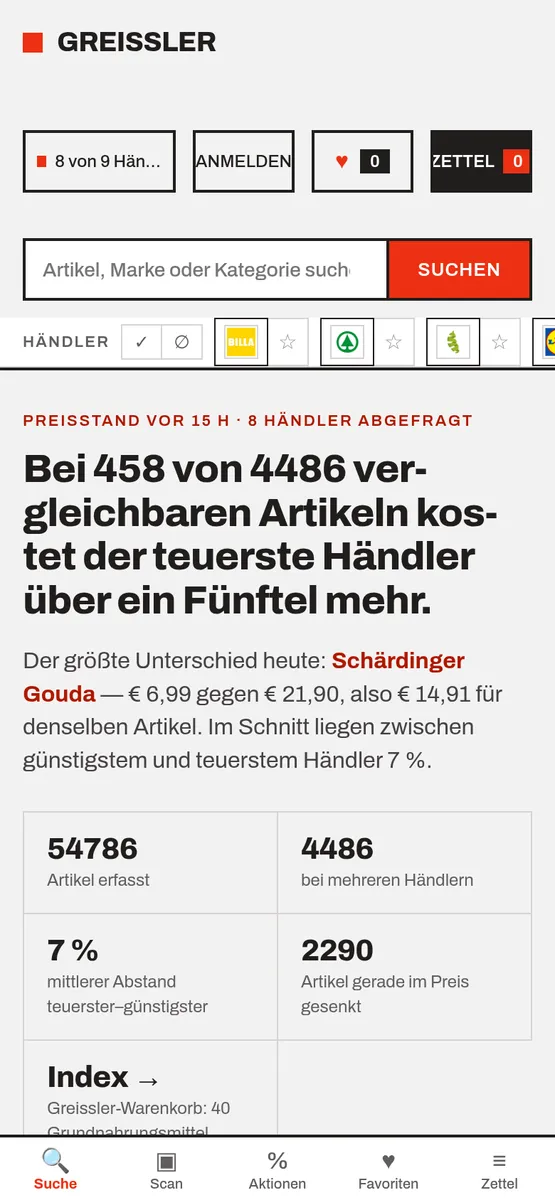
Greissler is a price comparison website for Austrian supermarkets.

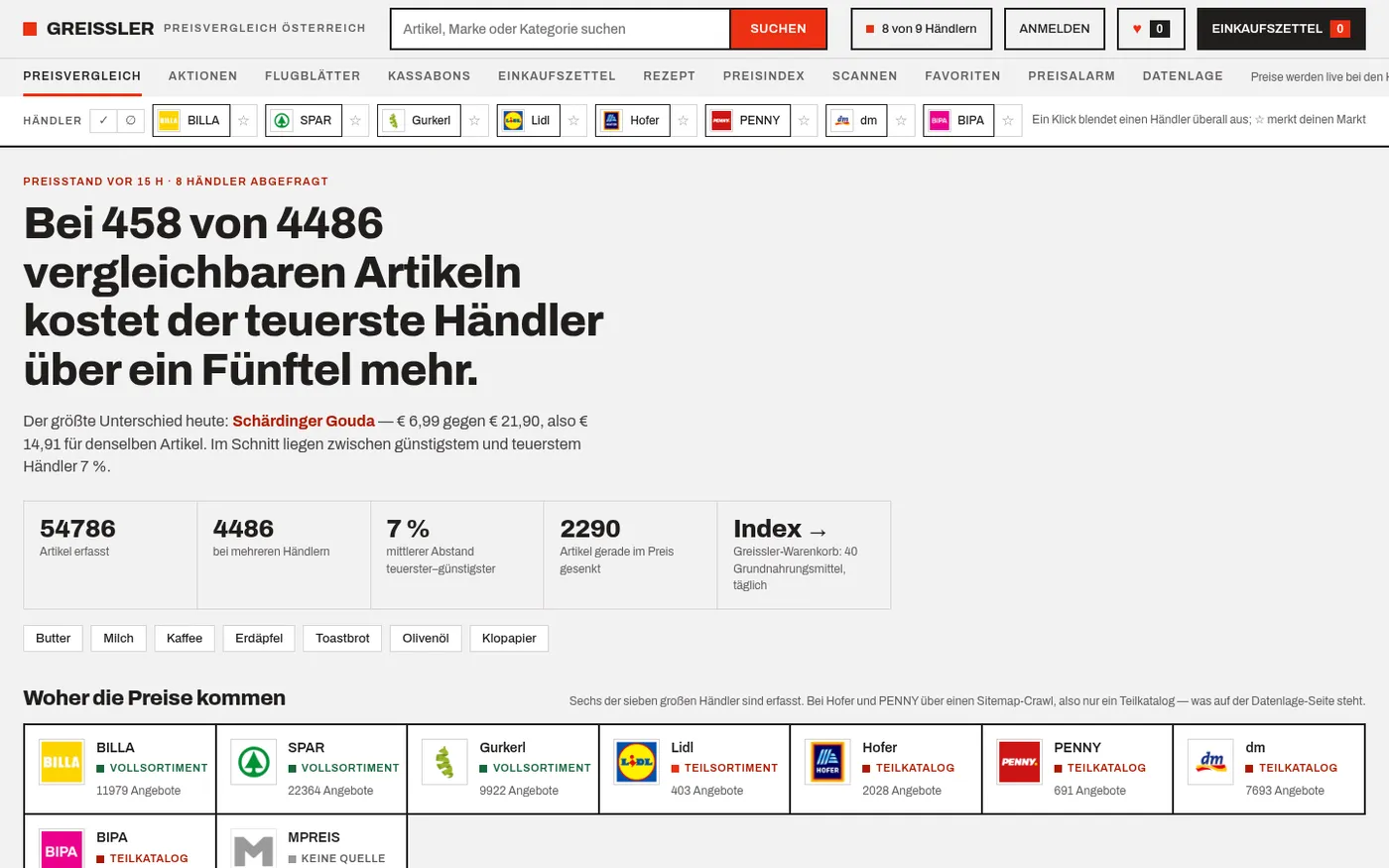
Greissler start page with the daily price gap between supermarkets

1 / 5 Greissler start page with the daily price gap between supermarkets

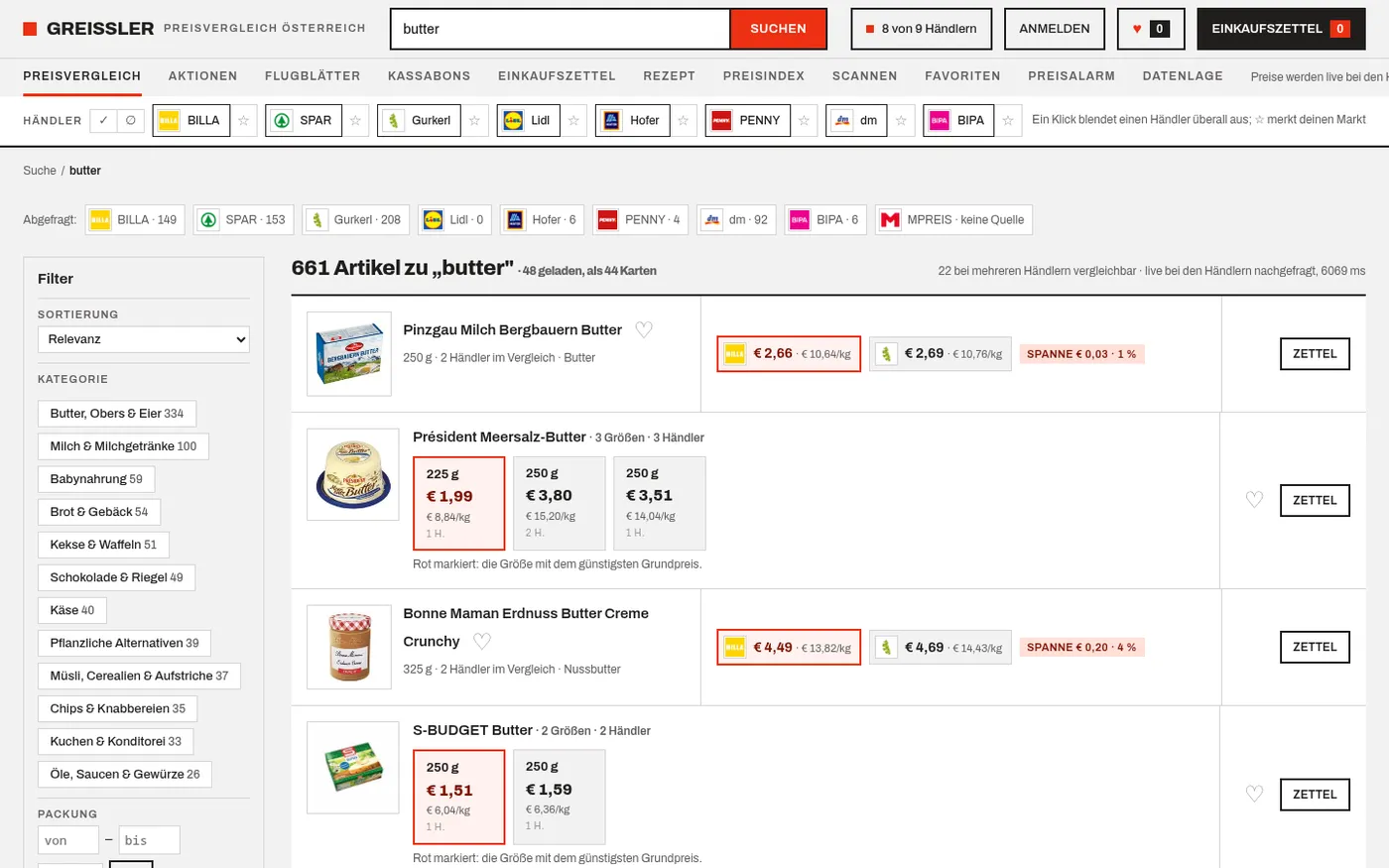
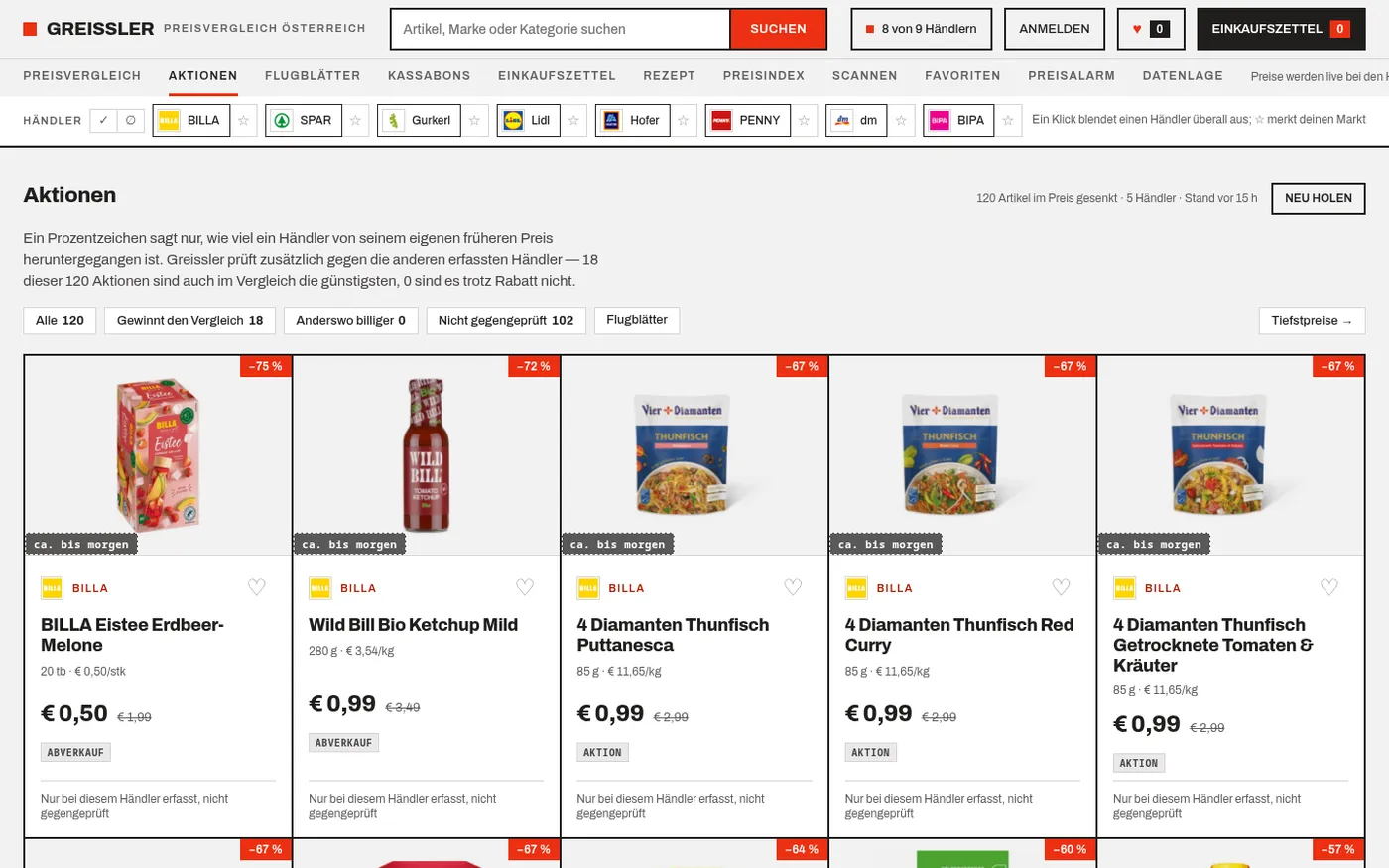
It collects prices from BILLA, SPAR, Hofer, Lidl, PENNY and Gurkerl plus the drugstores dm and BIPA every day and compares them by real unit price, so you can see where the same product is cheaper and whether a “deal” really is one.

  • Scale. About 50,000 products, 58,000 offers and 64,000 price observations, collected daily with a weekly deep crawl.
  • Honest deals. Discounts are checked against each product’s own price history.
  • Flyers. BILLA and BILLA PLUS flyer PDFs are parsed into offers.
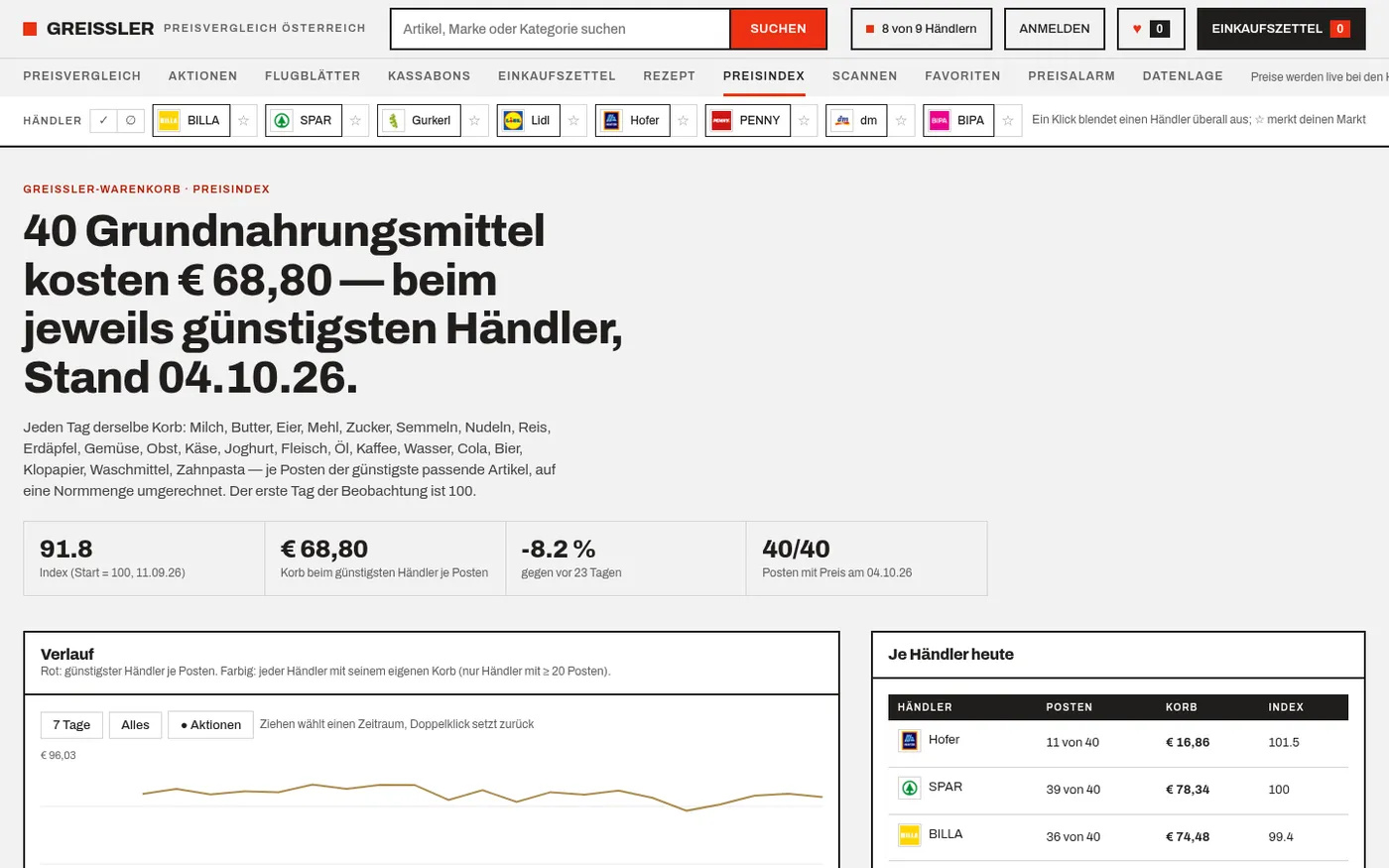
  • In the shop. Barcode scanning on the phone, a shopping list that works out the cheapest store, favourites and a price index.
  • Lean operations. Node.js with zero dependencies on a 1 vCPU container, SQLite in WAL mode, a watchdog and encrypted backups.

Personal project · Oct 2026In development, open source later

FinanzKuss

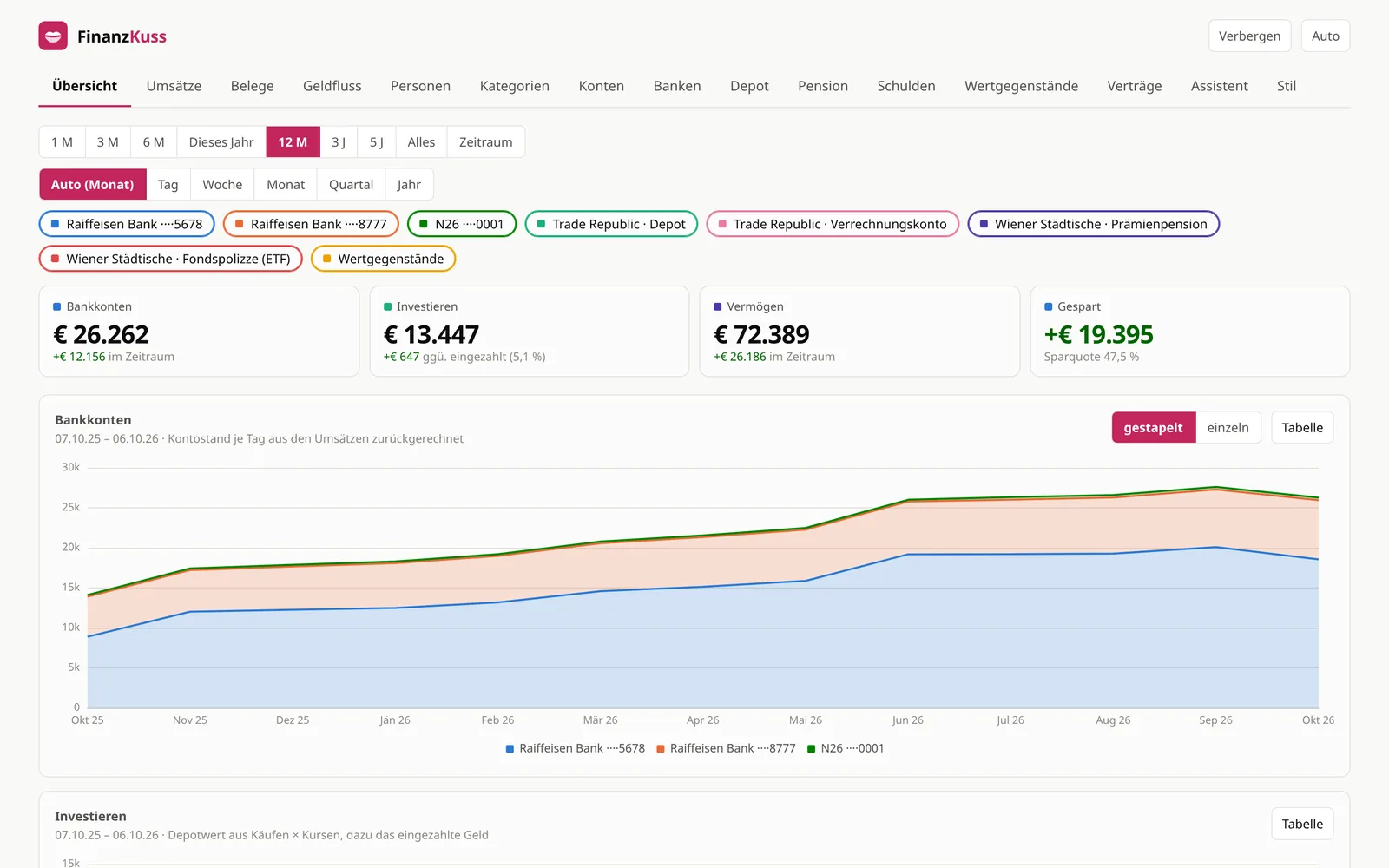
FinanzKuss is a self-hosted finance app that brings bank accounts, investments, pensions and receipts together on my own server.

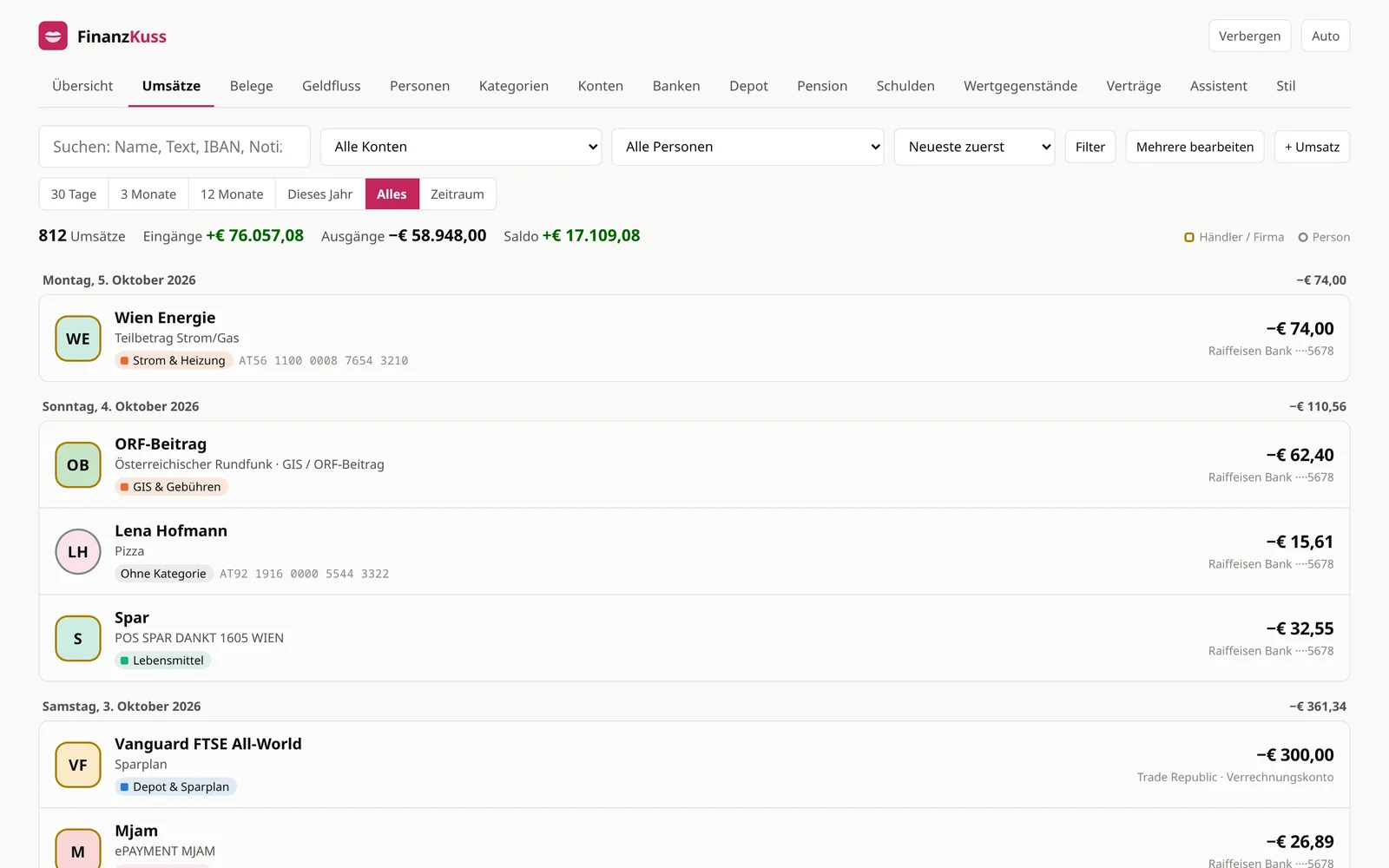
Overview with daily account balances, net worth and savings rate

1 / 5 Overview with daily account balances, net worth and savings rate

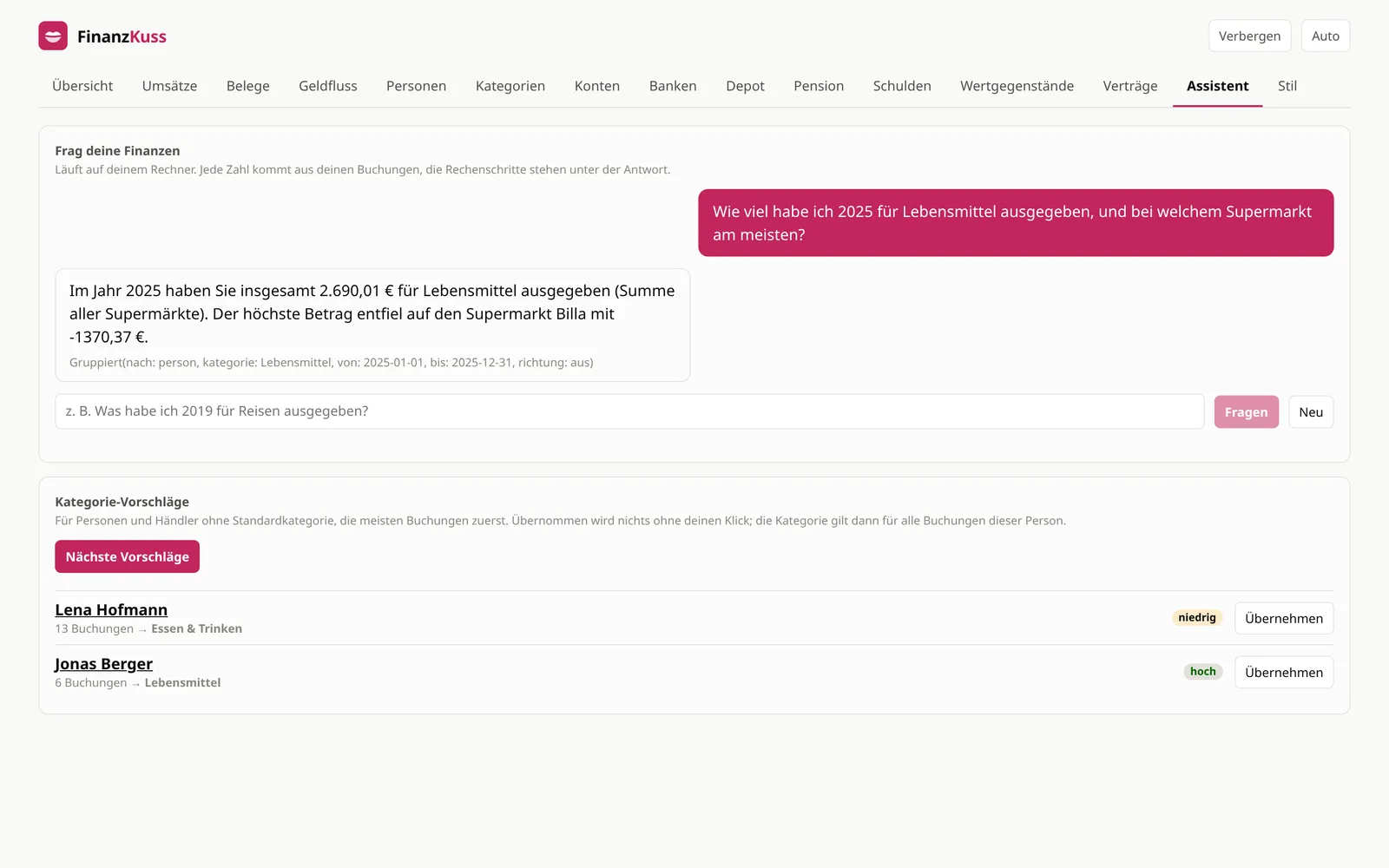
The plan: replace subscription apps like Finanzguru with something I own, and give it the features they are missing. It is in active development in a closed repository and will be released as open source once it is ready.

Most of what I learned was about connecting real data and giving a model the right tools: linking bank and broker accounts, designing one database that merges several sources without counting anything twice, and letting a local LLM answer questions only through read-only queries, the same pattern MCP servers are built on.

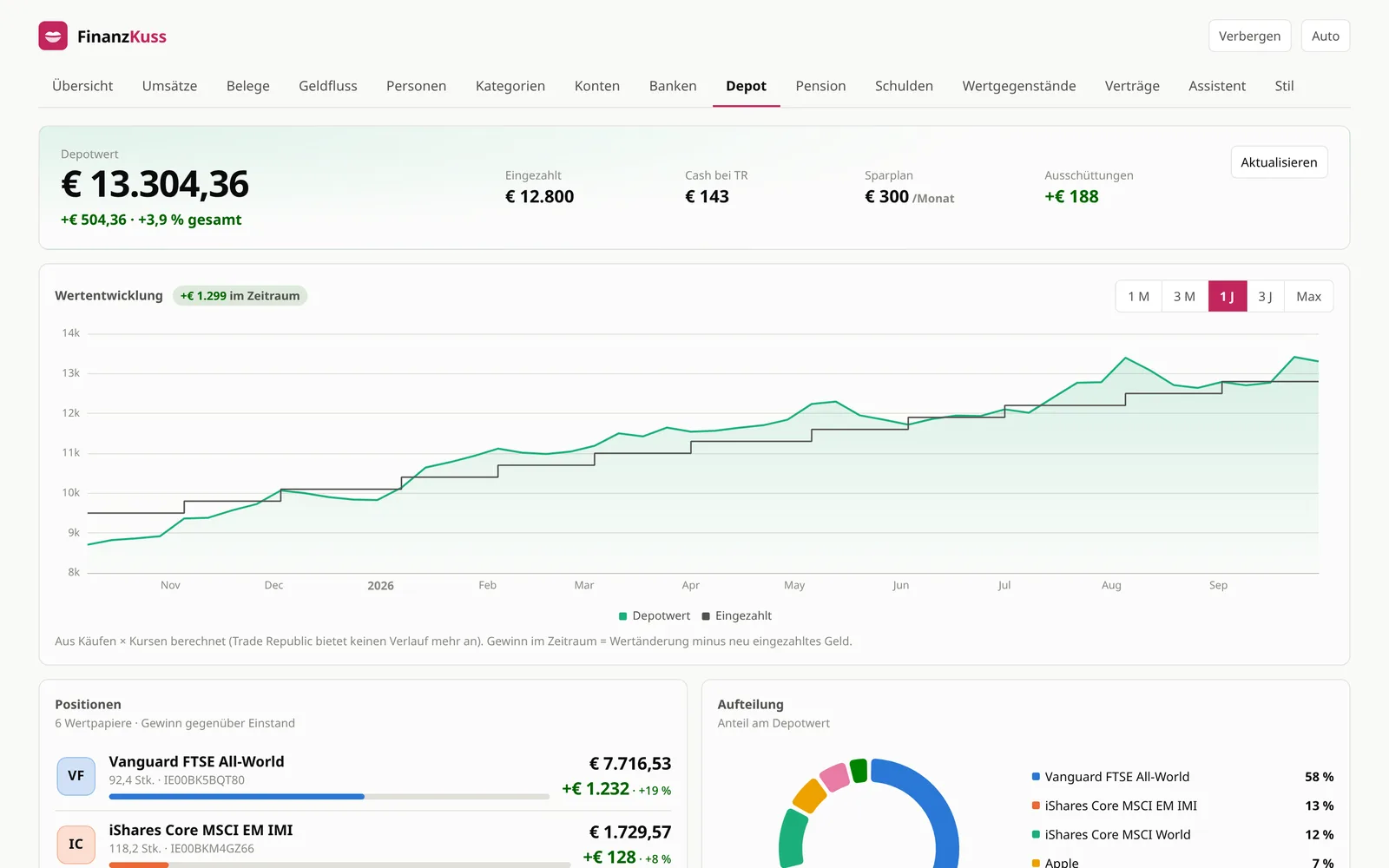
  • Connected accounts. Banks through PSD2 open banking, Trade Republic positions and savings plans, bank statement PDFs checked against their balances, and CSV exports.
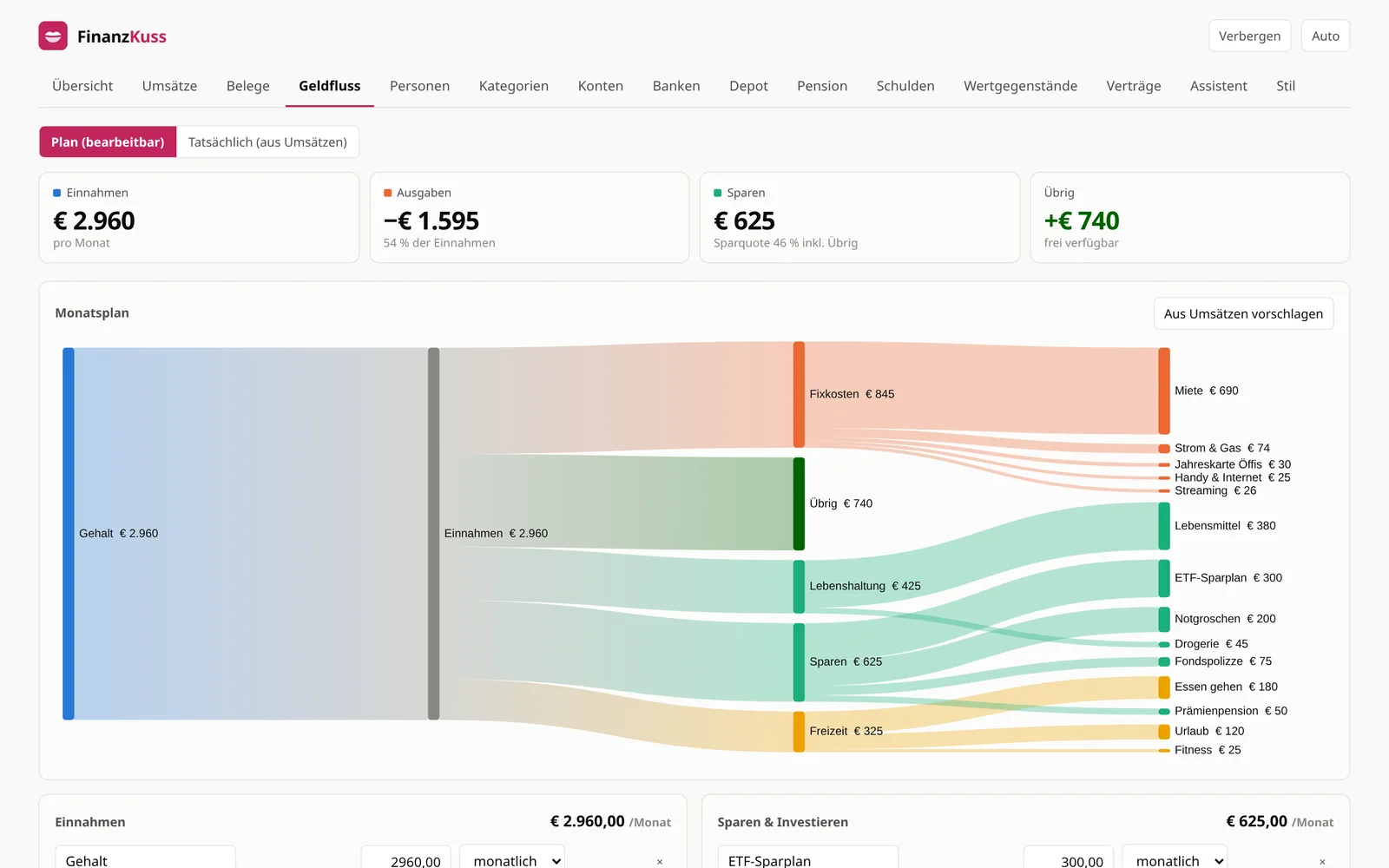
  • Cash flow. A monthly plan as a Sankey chart, from salary through fixed costs to savings, next to the same view built from real bookings.
  • Assistant with tools. A local model on Ollama never sees the database. It gets four read-only tools for sums, groups, bookings and categories, so every number in an answer comes from a tool call.
  • Receipts. Paperless-ngx invoices are matched to bookings by amount and date, and Amazon orders replace “AMAZON EU SARL” with the items actually bought.
  • One database, many sources. Amounts stored as whole cents, daily balances reconstructed from bookings, and duplicate detection across sources.
  • Private by design. Runs only on the home network or VPN, with keys encrypted at rest.

The screenshots show placeholder values, not my real finances (unfortunately): all names, amounts and IBANs are made up.

More projects

ShelfStudio

ShelfStudio designs 3D-printable shelf brackets for a real wooden board, starting from a photo of the board.

  • Detects the wooden board from a photo to get its real dimensions.
  • Parametric multi-tier supports with geometric patterns.
  • Exports watertight STL and GLB.

TypeScript · Three.js

Homelab

My homelab is a two-node Proxmox cluster running more than twenty self-hosted services.

  • Two Proxmox hosts with VMs and LXC containers, Proxmox Backup Server and a 16 TB NAS.
  • Media, photos with on-device ML (Immich with OpenVINO on an iGPU), Home Assistant with Zigbee, and dashboards.
  • Local LLM and video-generation workloads on a desktop GPU.
  • Every service has a runbook, and incidents get written postmortems.

Proxmox · Docker · Caddy · Syncthing

Jellyfin plugins
Small open-source plugins for the Jellyfin media server. Click a stack to see it full size.

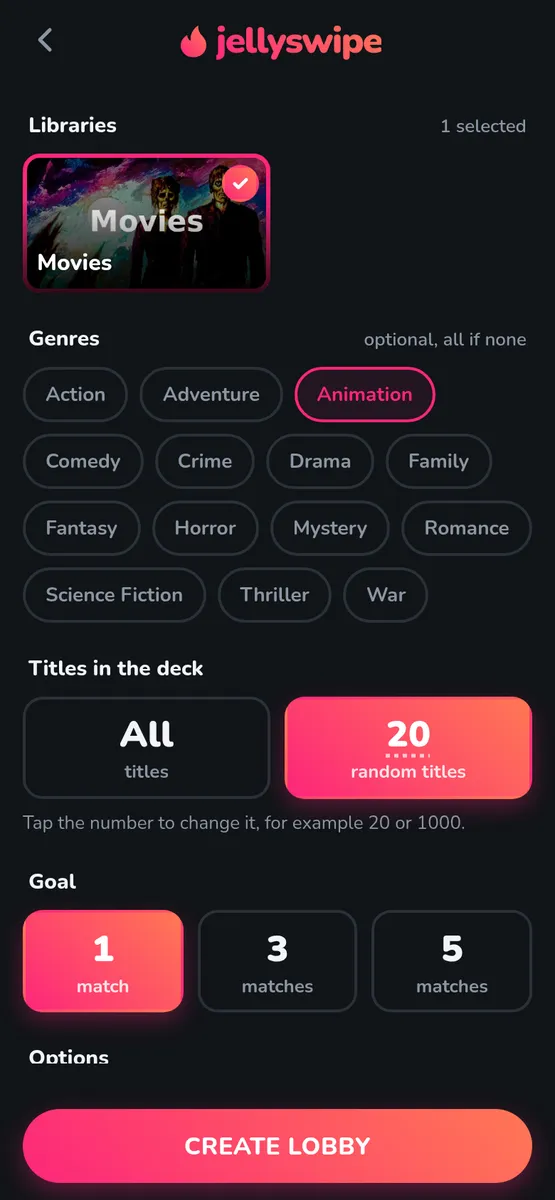
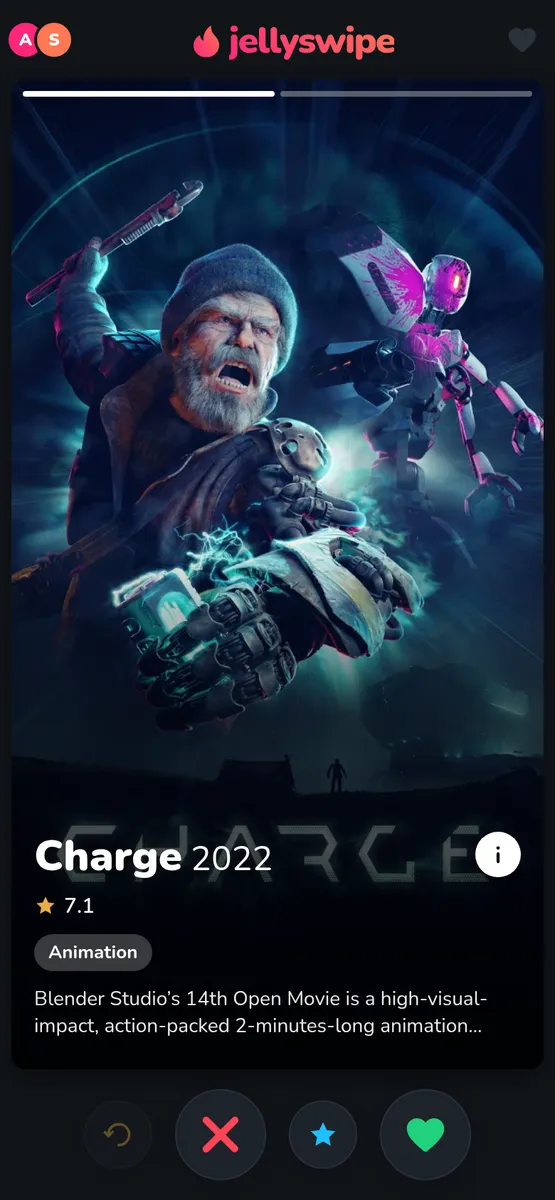
Swipe card for a movie

1 / 5 Swipe card for a movie

JellySwipe

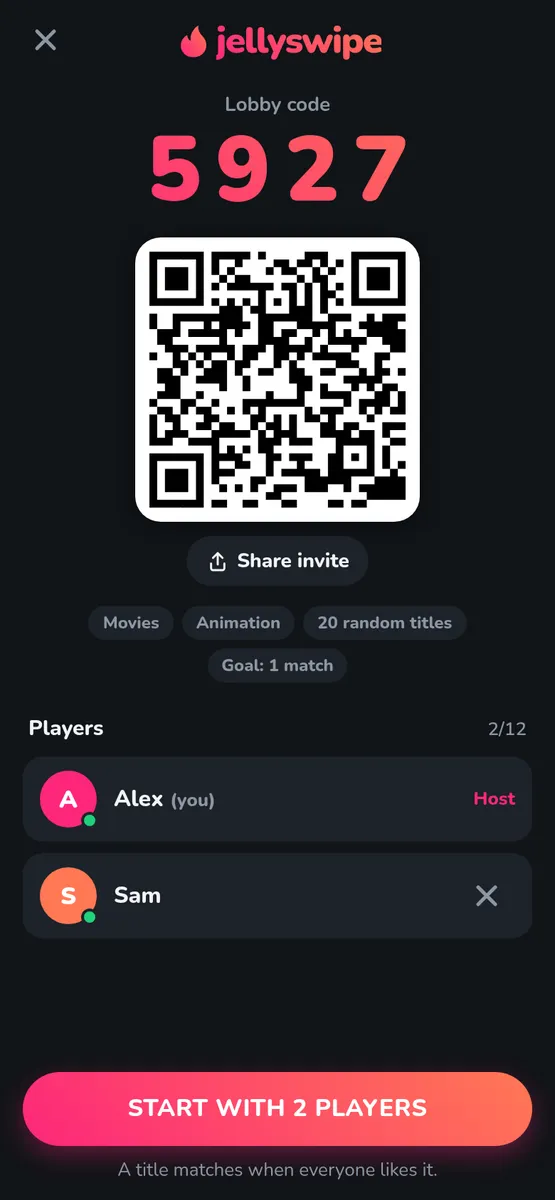
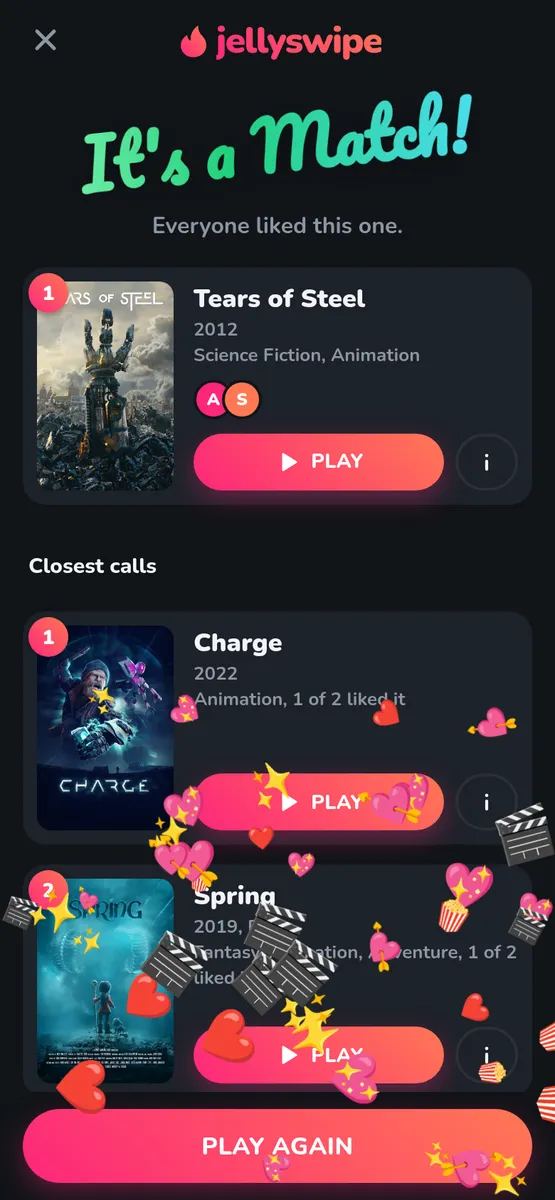
JellySwipe is Tinder for your Jellyfin library: everyone swipes on their phone until you match on what to watch.

A native Jellyfin plugin with its own entry in the Jellyfin sidebar. When everyone has liked the same title, it can start playing on the TV automatically.

  • Lobbies. Pick libraries and genres; friends join with a code or QR code.
  • Swipe cards. Drag physics, stamps, rewind and a match screen.
  • Compatibility. Builds for Jellyfin 10.9 through 12; open source.
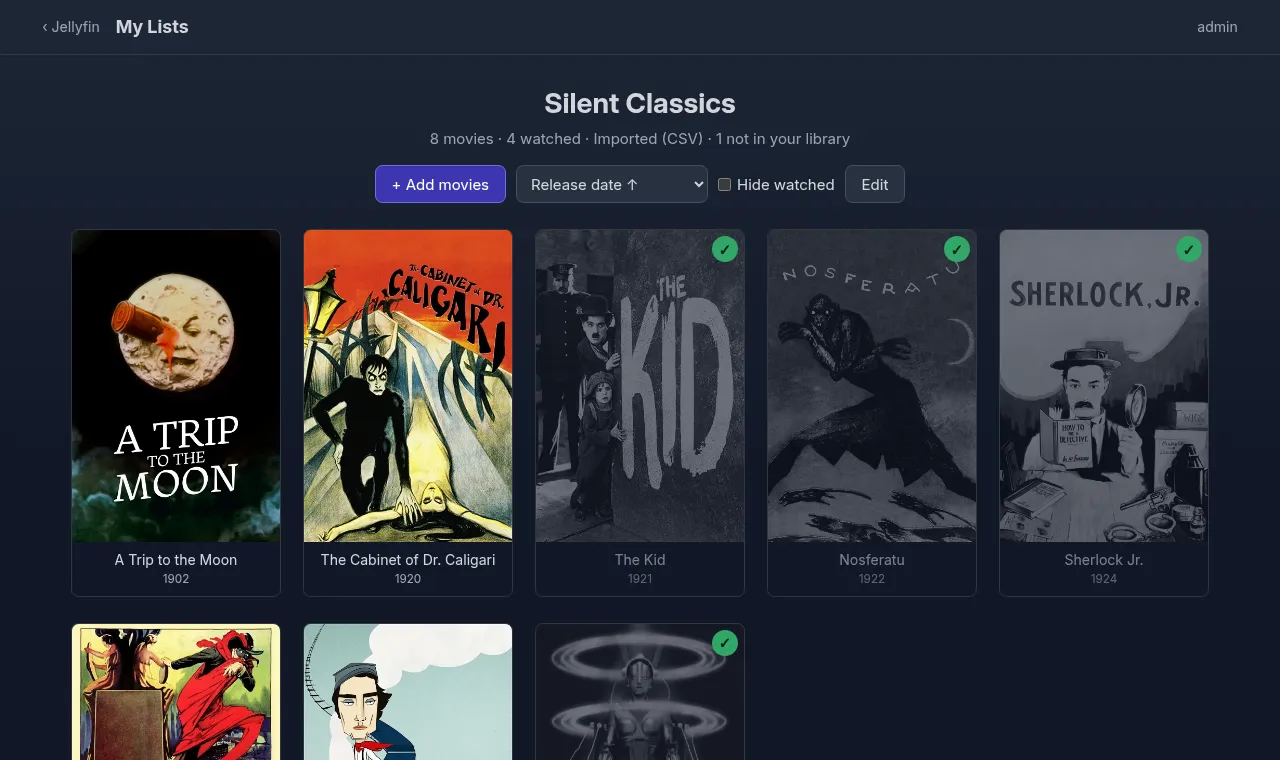
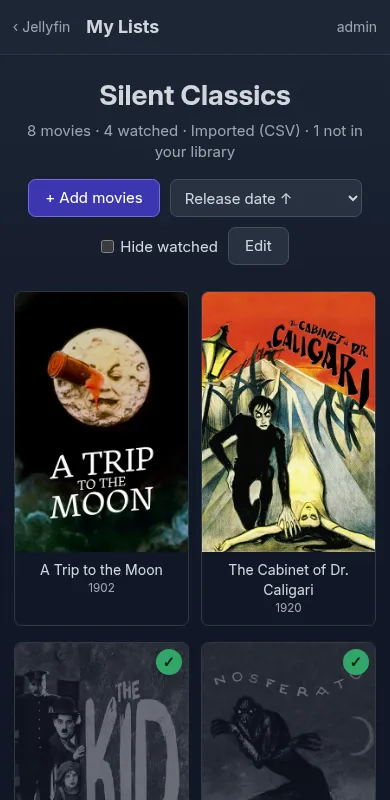
A list with watched movies greyed out

1 / 4 A list with watched movies greyed out

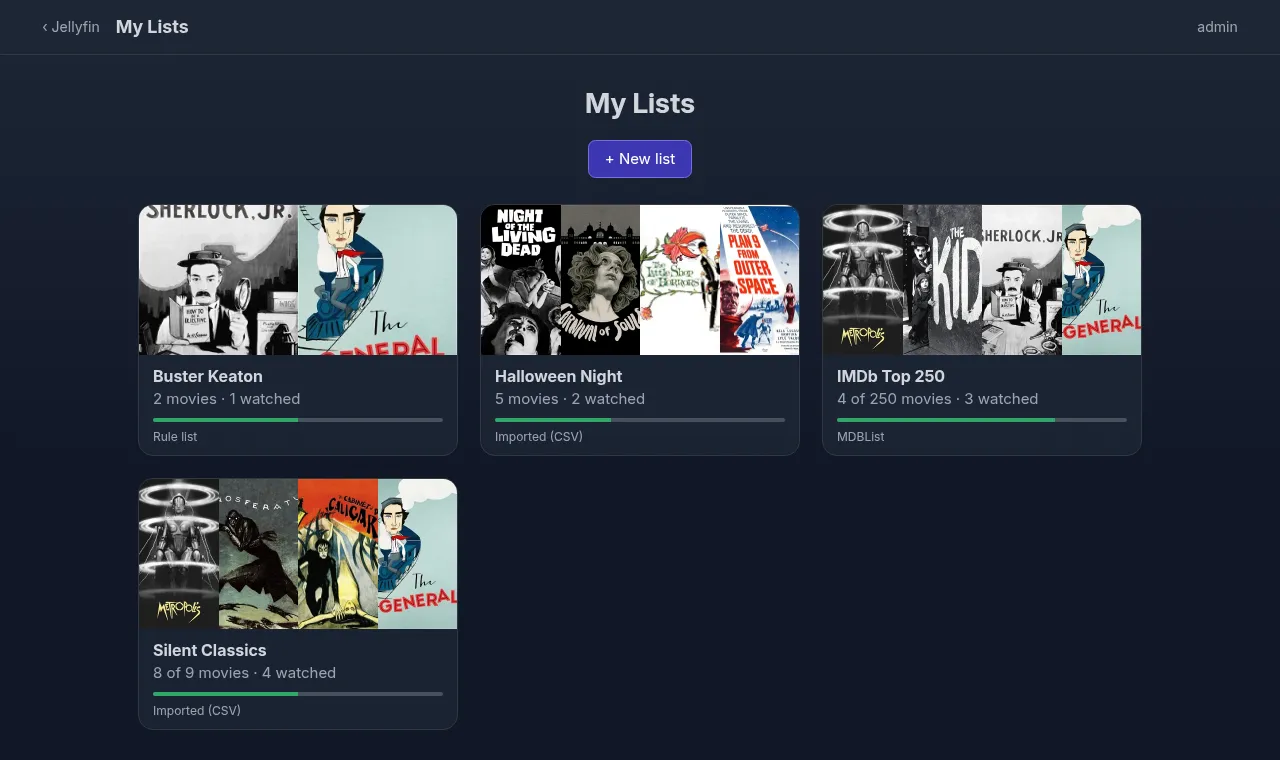
My Lists for Jellyfin

My Lists is a Jellyfin plugin for watch-checklists, such as the IMDb Top 250 or every film by one director.

Unlike a watchlist, watched movies stay in the list, greyed out with a check mark, so you can see “142 of 250 seen” at a glance.

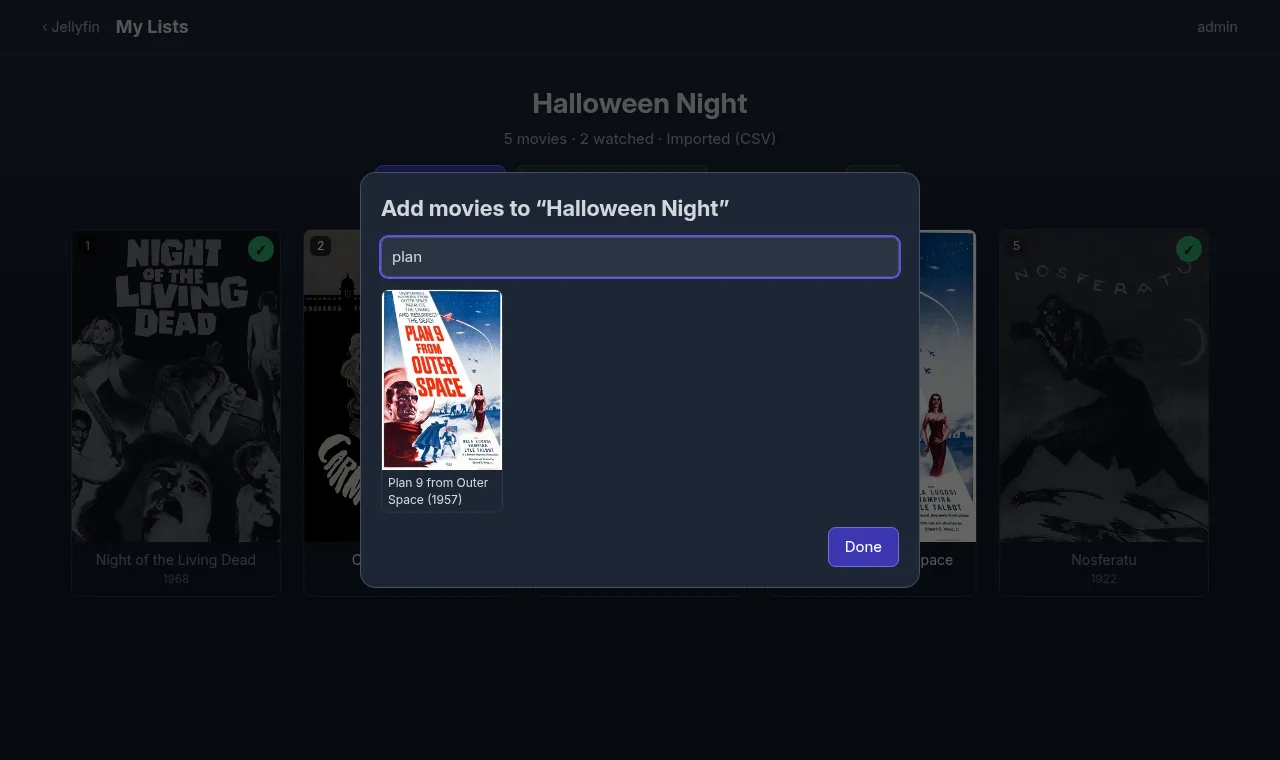
  • Four ways to fill a list. By hand, by rule (all films of a director or actor), from an MDBList URL, or from an IMDb or Letterboxd export.
  • Your order. Keep the source ranking or drag movies into your own order; watched state comes live from Jellyfin, per user.
  • Missing titles. Movies you don’t own yet are remembered and appear as soon as they are added.
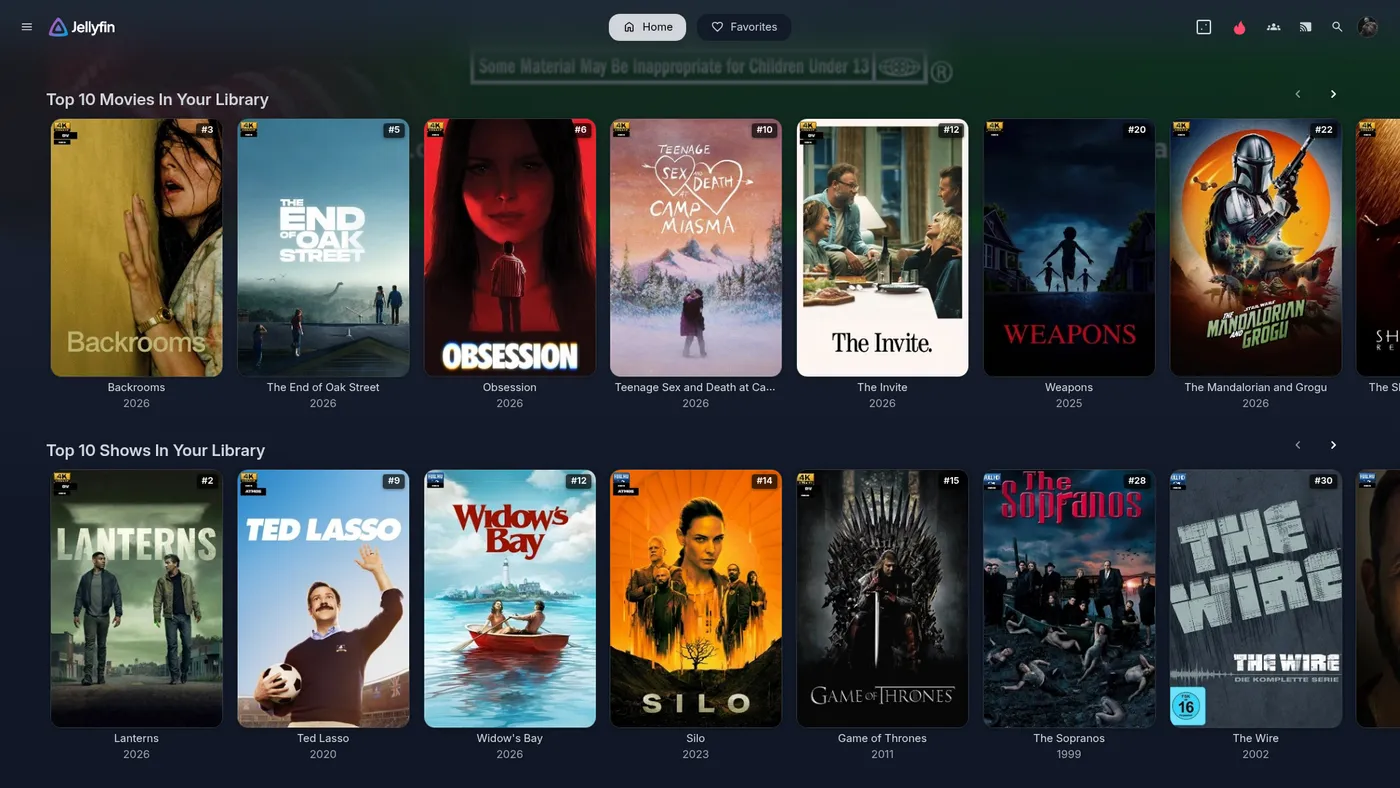
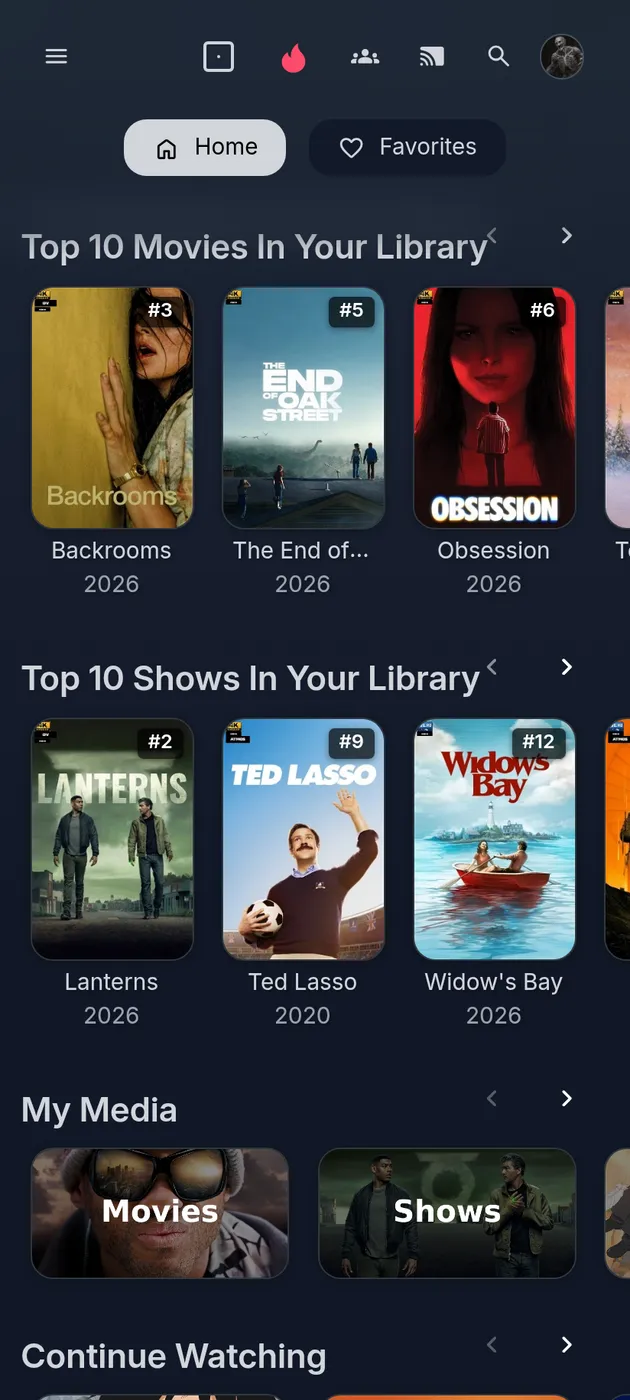
Top 10 movie and show rows on the Jellyfin home screen

1 / 3 Top 10 movie and show rows on the Jellyfin home screen

JellyTrends

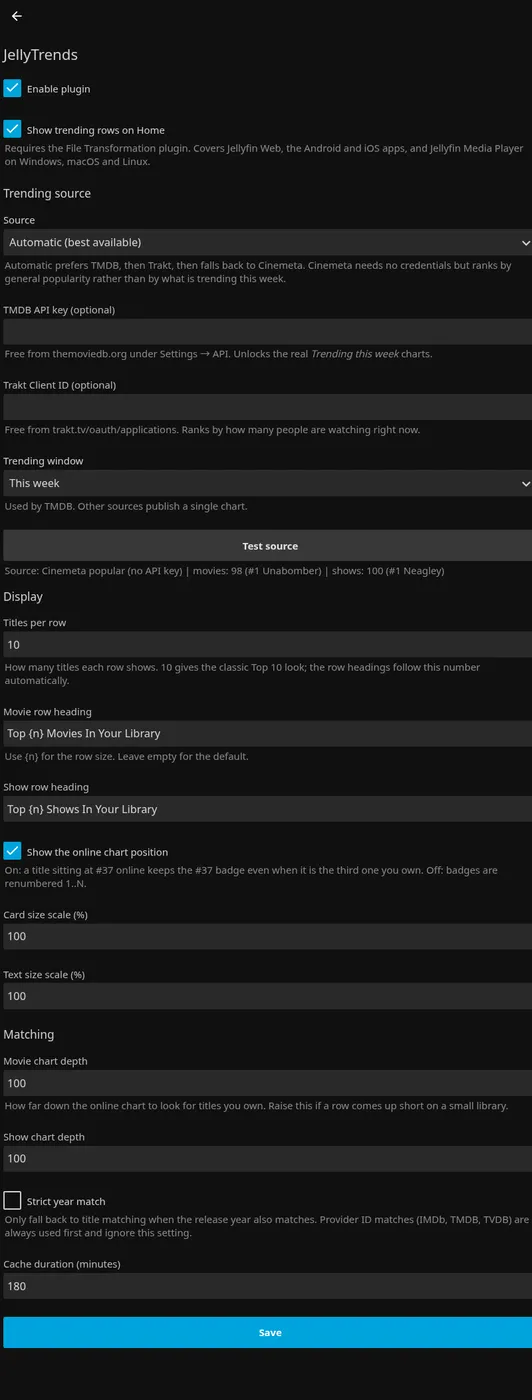
JellyTrends is a Jellyfin plugin that adds Netflix-style "Top 10" rows to the home screen, showing only titles you own.

Each title keeps its real rank in the online chart: if a show is #36 worldwide, the badge says #36, even if it’s the sixth one in your library.

  • Chart sources. TMDB, Trakt or the keyless Cinemeta catalog, matched by IMDb, TMDB or TVDB id.
  • Looks built in. Uses Jellyfin’s own section and card markup, on desktop, phone and TV.